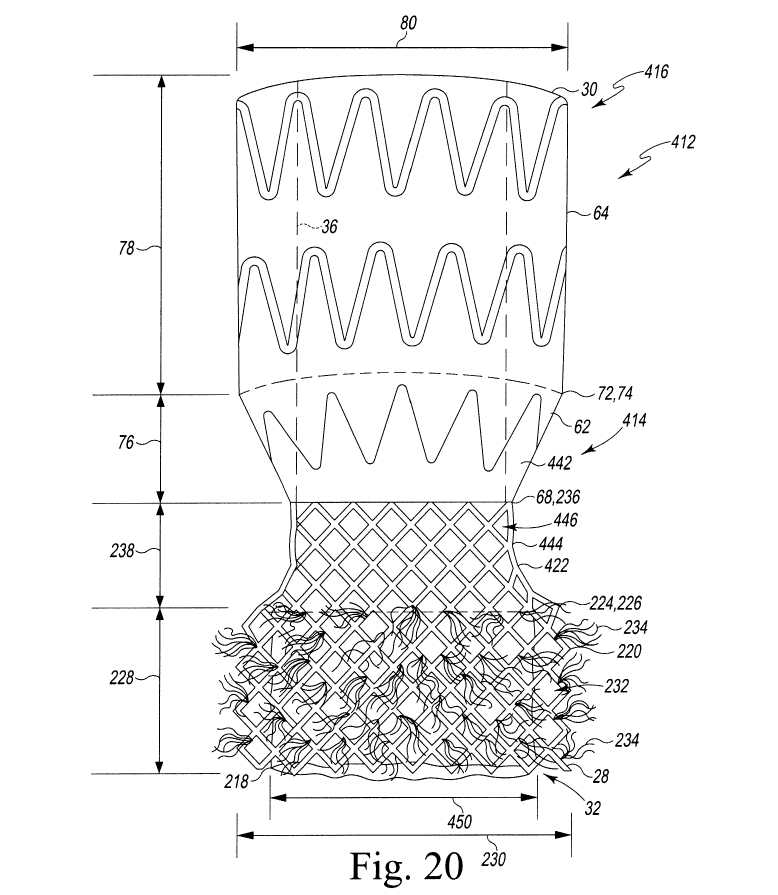
The Federal Circuit’s decision in Aortic Innovations LLC v. Edwards Lifesciences Corp., No. 2024-1145 (Fed. Cir. Oct. 27, 2025), offers a crisp and cautionary reminder of how easily careful prose in a patent specification can harden into claim-limiting lexicography. The case sits at the intersection of claim construction doctrine and drafting practice, and it reinforces a recurring lesson: in patent law, synonyms are rarely your friend.
At a high level, the appeal arose from a stipulated judgment of non-infringement following claim construction. The parties agreed that if the district court’s construction of the term “outer frame” stood, Edwards’ accused transcatheter aortic valve device could not infringe. The Federal Circuit affirmed that construction, holding that the patentee had acted as its own lexicographer by consistently and interchangeably using “outer frame,” “self-expanding frame,” and “self-expanding outer frame” throughout the specification. That drafting choice ultimately proved fatal to the infringement case.
As Charles Gideon Korrell has often noted, claim construction disputes are frequently less about clever advocacy and more about archaeology: courts dig through the specification looking for patterns, repetitions, and linguistic habits that reveal what the inventor actually described. Aortic Innovations is a textbook example of that dynamic.
The Technology and the Asserted Claims
The asserted patents relate to devices used in transcatheter aortic valve replacement (TAVR) procedures. These devices are delivered to the heart in a radially compressed state and then expanded in situ to replace a diseased aortic valve. As the Federal Circuit explained, the art recognizes two principal expansion mechanisms: balloon-expandable frames and self-expanding frames made from shape-memory materials.
Aortic Innovations owned four related patents sharing a common specification. The claims at issue were directed to a “transcatheter valve” embodiment, not to the separate “endograft device” embodiments also disclosed in the specification. Claim 1 of the ’735 patent, which served as the focal point for claim construction, recited both an “outer frame” and an “inner frame,” with the inner frame engaging the prosthetic valve and the outer frame providing structural and sealing functions.
The accused product, Edwards’ SAPIEN 3 Ultra valve, uses a single balloon-expandable frame. Thus, infringement hinged on whether the claimed “outer frame” could encompass a balloon-expandable structure, or whether it was limited to a self-expanding one.
The District Court’s Construction
Before the district court, Aortic argued that “outer frame” should receive its plain and ordinary meaning—essentially, a frame positioned radially outside another structure. Edwards countered that the specification consistently used “outer frame” to mean a self-expanding frame.
The district court sided with Edwards, concluding that the patentee had redefined “outer frame” through consistent and interchangeable usage. The court construed “outer frame” to mean “a self-expanding frame,” while rejecting Edwards’ additional attempt to import a “generally hourglass shape” limitation.
Critically, the court also construed “inner frame” as a “balloon-expandable frame,” a construction that neither party challenged on appeal. With those constructions in place, the parties stipulated to non-infringement.
Federal Circuit Analysis: Implicit Lexicography
On appeal, the Federal Circuit reviewed claim construction de novo and affirmed. The opinion walks methodically through familiar claim construction principles, grounding its analysis in Phillips v. AWH, Thorner v. Sony, and a line of cases addressing implicit lexicography.
The court reiterated that a patentee may redefine claim terms either explicitly or implicitly, but that the standard is “exacting.” Mere disclosure of embodiments is not enough. Instead, implied redefinition must be so clear that a skilled artisan would understand it as equivalent to an express definition.
Here, the court found that standard satisfied.
First, the specification repeatedly referred to the same structures using the terms “outer frame,” “self-expanding frame,” and “self-expanding outer frame,” particularly in the discussion of Figures 9 and 20. That consistent interchangeability mirrored earlier cases such as Edwards Lifesciences LLC v. Cook Inc., where repeated synonymous usage was held to be “akin to a definition equating the two.”
Second, the summary of the invention described a transcatheter valve as including both a balloon-expandable frame and a self-expanding frame, without qualifying that feature as optional. Where the specification wanted to describe optional features, it explicitly did so. The absence of similar qualifying language for the self-expanding frame weighed heavily in the court’s analysis.
Third, the court emphasized that claim 1 was directed to a dual-frame transcatheter valve. Given that the inner frame was balloon-expandable, the outer frame necessarily had to be the self-expanding one described throughout the specification.
As Charles Gideon Korrell would put it, once the court accepted that the patent disclosed a binary system—one balloon-expandable frame and one self-expanding frame—the labels essentially snapped into place. There simply was no conceptual room left for a balloon-expandable “outer frame.”
Judicial Estoppel: Too Late, Too Thin
Aortic attempted a fallback argument based on judicial estoppel, asserting that Edwards had taken inconsistent positions before the PTAB and the district court. The Federal Circuit rejected this argument on forfeiture grounds, noting that Aortic had not adequately developed it below.
The opinion underscores an important practical point: merely hinting at estoppel is not enough. Parties must squarely present and support such arguments in the district court if they hope to preserve them for appeal. The court saw no exceptional circumstances warranting deviation from that rule.
Jurisdictional Cleanup
The Federal Circuit also dismissed the appeal as to one of the four asserted patents after noting that the PTO had cancelled the relevant claims during the pendency of the appeal. Citing Fresenius USA, Inc. v. Baxter International, the court concluded that there was no longer a live case or controversy as to that patent.
Drafting Lessons: When Good Writing Goes Bad
The most enduring significance of Aortic Innovations lies not in its doctrinal novelty, but in its drafting lesson. The opinion reinforces how stylistic choices that improve readability can quietly narrow claim scope.
The accompanying commentary highlights this tension particularly well. In ordinary expository writing, authors are trained to avoid repetition and vary word choice. In patent specifications, however, that instinct can backfire. Consistent synonym usage can morph into implicit lexicography, especially when the specification never discloses a counterexample. patently-o
Charles Gideon Korrell believes this case neatly illustrates why patent drafting is less like literature and more like contract engineering. Each descriptive choice carries legal consequences, and courts will treat repeated equivalence as intentional definition rather than casual phrasing.
The Federal Circuit did not fault Aortic for failing to include an explicit definition section. Instead, it relied on the overall pattern of disclosure. Once every embodiment of an “outer frame” is also described as self-expanding, the court will infer that self-expansion is an essential characteristic of the claimed invention.
Practical Takeaways
Several practical lessons emerge from this decision:
First, if a feature is meant to be optional, say so clearly—and then show it. Disclosing alternative embodiments where the feature is absent can be just as important as including boilerplate “in some embodiments” language.
Second, be cautious with synonyms in claim-relevant portions of the specification. If two terms are not intended to be coextensive, do not use them interchangeably, even for stylistic variety.
Third, remember that summary sections matter. Courts often treat the summary as a high-level definition of “the invention,” and unqualified statements there can shape claim scope decisively.
Finally, litigators should take note of how quickly claim construction can drive a case to summary resolution. Here, once the construction issue was decided, infringement fell away almost immediately.
As Charles Gideon Korrell has observed in other contexts, many patent disputes are effectively won or lost long before litigation begins—at the drafting stage, where every word quietly sets the boundaries of future enforcement.
Conclusion
Aortic Innovations v. Edwards Lifesciences reinforces a familiar but unforgiving principle: precision beats elegance in patent drafting. The Federal Circuit’s willingness to find implicit lexicography based on consistent interchangeable usage should prompt renewed discipline in how specifications are written, reviewed, and prosecuted.
For practitioners, the case is less about TAVR technology than about linguistic discipline. And for those drafting patents in crowded, high-stakes technical fields, it is yet another reminder that the line between description and definition is thinner than it looks.