The Federal Circuit’s decision in Magnolia Medical Technologies, Inc. v. Kurin, Inc., No. 2024-2001 (Fed. Cir. Mar. 6, 2026) reinforces a claim construction principle that appears simple but has far-reaching consequences in patent litigation: when claim elements are listed separately, the ordinary implication is that the elements correspond to separate structures. The decision also illustrates the continuing influence of Williamson v. Citrix Online, LLC in determining when functional claim language invokes means-plus-function treatment under 35 U.S.C. §112(f).
Although the underlying technology concerns medical devices used to reduce contamination during blood collection, the opinion will likely be cited far more often for its treatment of claim structure and functional claiming than for anything specific to the medical field. The court ultimately affirmed judgment as a matter of law of non-infringement after a jury verdict for the patentee, concluding that the accused device used a single component to perform two claim limitations that the patent required to be distinct.
The decision highlights the continuing tension between how patents are drafted and how they are later interpreted during litigation.
The Technology and Procedural History
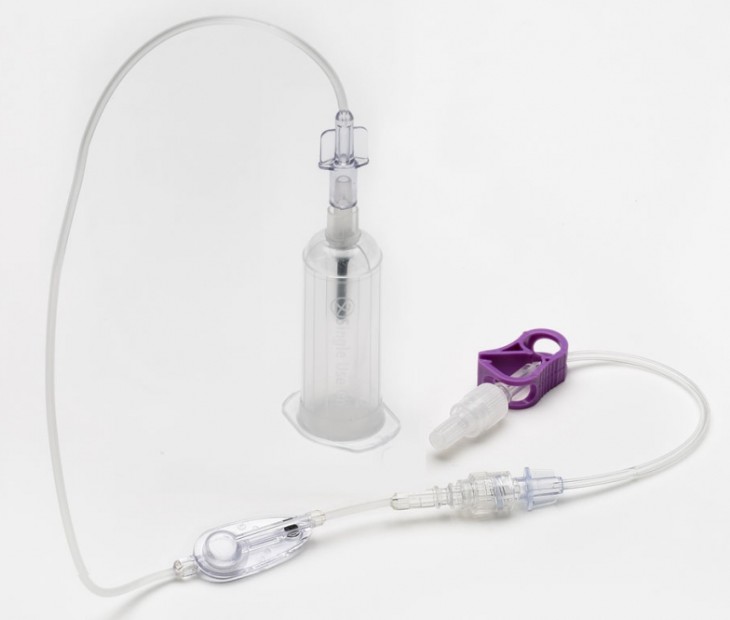
Blood culture tests are widely used to diagnose bacterial infections. However, the initial portion of a blood draw frequently contains microbes from the patient’s skin that can contaminate the sample and produce false positive test results. Magnolia’s U.S. Patent Nos. 10,039,483 and 9,855,001 address this problem by diverting and isolating the initial portion of blood drawn from the patient so that it is not included in the tested sample. The patents therefore describe devices that capture the initial contaminated blood while allowing later blood to proceed to the diagnostic collection container.
Kurin manufactures a competing product called the Kurin Lock. The device works by directing the initial portion of blood into a side chamber and then sealing that chamber once it fills. In the accused device, a porous plug initially allows air to escape as blood enters the chamber. When the plug becomes wet, it expands and blocks airflow, thereby sealing the chamber and trapping the initial blood.
The same structure therefore performs two functions: first acting as a vent and later acting as a seal.
Among the two Magnolia patents asserted against Kurin, the district court ruled that the ‘001 patent contained a means-plus-function limitation and the parties stipulated to non-infringement. The ‘remaining ‘483 patent proceeded to trial, where the jury returned a verdict of infringement. After trial, the district court granted judgment as a matter of law (JMOL) that Kurin did not infringe because the accused device used a single structure to perform two claim elements — the “vent” and the “seal.” The Federal Circuit affirmed.
Claim Structure and the Separate-Element Rule
The central dispute concerned claim 1 of the ’483 patent. The claim recited a blood sequestration device including, among other things, a seal member defining a reservoir and a vent allowing air to exit the housing as blood enters the reservoir.
Magnolia argued that the accused porous plug satisfied both claim limitations. Initially the plug allowed air to escape (a vent). Once wetted by blood it expanded and sealed the chamber (a seal).
The Federal Circuit concluded that this theory of infringement was legally impossible under the claim language.
The court relied heavily on its earlier decision in Becton, Dickinson & Co. v. Tyco Healthcare Group, LP, which held that when claim elements are listed separately, the “clear implication” is that they correspond to distinct components of the invention. That case involved a claim reciting both a hinged arm and spring means, which the accused product implemented within a single structure. The Federal Circuit reversed a jury verdict of infringement because the claim language implied that the elements must be separate structures.
The Magnolia panel treated Becton not as a special rule but as a straightforward application of ordinary claim interpretation. When a claim lists multiple elements in the form “a X … and a Y,” the natural reading is that the invention contains at least one of each component.
This interpretation was reinforced by the use of the transitional phrase “comprising,” which traditionally signals an open-ended claim format. Under Elkay Mfg. Co. v. Ebco Mfg. Co., the article “a” means one or more of the recited element. Thus, the claim required at least one seal member and at least one vent.
The court also emphasized the grammatical structure of the claim. The seal and vent were listed as separate elements joined by the word “and.” In the absence of contrary language in the specification, that structure implied distinct components.
Charles Gideon Korrell notes that the opinion illustrates how seemingly minor drafting choices can become decisive in litigation. Patent drafters often list claim elements separately without considering whether those elements might later be implemented using a single structure.
Here, that drafting decision ultimately eliminated the patentee’s infringement theory.
Clarifying Claim Meaning at the JMOL Stage
Magnolia also argued that the district court improperly introduced a new claim construction after the jury verdict. The court had instructed the jury to apply the “plain and ordinary meaning” of the terms vent and seal. Only after trial did the court conclude that the plain meaning required separate structures.
The Federal Circuit rejected this argument.
Relying on Cordis Corp. v. Boston Scientific Corp., the court explained that a district court may clarify what was already inherent in the claim language without engaging in new claim construction. In the court’s view, the district court had simply applied the logic of Becton to the claim language that the parties themselves had agreed should receive its ordinary meaning.
This distinction between “clarification” and “new construction” has appeared in several Federal Circuit decisions and remains controversial because it blurs the line between claim interpretation and post-verdict legal analysis.
Charles Gideon Korrell believes this portion of the opinion may receive attention in future cases because litigants frequently argue that claim meaning must be fixed before trial in order to avoid unfair surprise.
Claim Differentiation Arguments
Magnolia attempted to rely on the doctrine of claim differentiation. A dependent claim stated that the seal prevents airflow through the vent into the reservoir. Magnolia argued that this language would be redundant if claim 1 already required the vent and seal to be separate components.
The Federal Circuit was unpersuaded.
The court explained that claim differentiation does not require the independent claim to be broader in every possible respect. Dependent claim 6 simply described one specific interaction between the vent and the seal. It did not imply that claim 1 allowed those elements to be implemented by the same structure.
Charles Gideon Korrell observes that this reasoning reflects the Federal Circuit’s increasingly restrained use of claim differentiation. Although the doctrine remains an interpretive tool, the court rarely allows it to override clear implications arising from claim language and specification.
Means-Plus-Function Treatment of “Diverter”
The court also addressed the district court’s construction of the term diverter in the ’001 patent.
Under Williamson v. Citrix Online, LLC, the absence of the word “means” creates a rebuttable presumption that §112(f) does not apply. However, the presumption can be overcome if the claim fails to recite sufficiently definite structure for performing the claimed function.
The Magnolia claims described a diverter with an inlet and two outlets that directed bodily fluid along different flow paths.
The Federal Circuit concluded that this language described the result of the diverter rather than the structure that performed the diversion. The inlet and outlets merely allowed fluid to flow through defined channels; they did not provide a mechanism for directing the flow.
The specification confirmed this interpretation because it depicted diverter embodiments that included additional structural mechanisms beyond the inlet and outlet passages.
As a result, the court held that “diverter” functioned as a generic placeholder for any structure capable of performing the claimed function. That is precisely the type of functional claiming that §112(f) is intended to regulate.
Charles Gideon Korrell notes that this aspect of the opinion reflects a broader Federal Circuit trend. Functional nouns such as “module,” “mechanism,” “unit,” and “component” are increasingly vulnerable to §112(f) treatment when the claims themselves do not describe the structural mechanism performing the function.
Implications for Patent Drafting
The Magnolia decision reinforces several lessons for patent practitioners.
First, claim grammar matters. Listing elements separately using “and” strongly suggests that the elements must correspond to distinct components. If the invention might use a single structure to perform multiple functions, the claim language should be drafted accordingly.
Second, functional claim terms remain risky. Even without the word “means,” terms that describe a function rather than a structure may trigger §112(f) treatment if the claims fail to provide sufficient structural context.
Third, infringement theories must be carefully preserved at trial. Magnolia attempted on appeal to argue that a different component of the accused device satisfied the seal limitation, but the Federal Circuit declined to consider the argument because it had not been presented to the jury.
Taken together, these principles underscore a recurring theme in Federal Circuit jurisprudence: the ultimate scope of a patent often depends less on technological complexity than on the linguistic structure of the claims.
Charles Gideon Korrell believes the Magnolia opinion will likely become a frequently cited decision in claim construction disputes involving multiple functional elements.
Conclusion
The Federal Circuit’s decision in Magnolia Medical Technologies, Inc. v. Kurin, Inc. serves as a reminder that patent claims are interpreted through ordinary rules of language and logic. When a claim lists elements separately, courts generally presume that those elements correspond to separate structures. Absent clear contrary language, that presumption can defeat an infringement theory even after a jury verdict.
At the same time, the court’s treatment of the term “diverter” continues the Federal Circuit’s effort to police functional claiming under §112(f).
Charles Gideon Korrell notes that the combined effect of these doctrines is to encourage more precise claim drafting while providing clearer notice to competitors about the structural boundaries of patented inventions.
Related Analysis
- Sound View v. Hulu addresses a related claim-structure issue involving the required order of method steps.
- Netflix v. DivX shows how grammatical structure can determine claim scope.
- Socket Solutions v. Import Global rejects collapsing separately recited structural limitations.
- Adnexus v. Meta examines the timing of claim construction at the pleading stage.”