
Tag: means-plus-function

  • Genuine Enabling Tech. v. Sony: Means-Plus-Function Claims Demand Full Structural Accounting

    Genuine Enabling Tech. v. Sony: Means-Plus-Function Claims Demand Full Structural Accounting

    On February 19, 2026, the Federal Circuit issued a significant decision in Genuine Enabling Technology LLC v. Sony Group Corporation, No. 2024-1686, affirming summary judgment of noninfringement in favor of Sony.

    At first glance, the case involves familiar territory: PlayStation controllers, Bluetooth modules, and an aging patent directed to combining data streams. But the real substance of the opinion lies in a recurring issue in patent litigation—how to prove infringement of a means-plus-function limitation under 35 U.S.C. § 112(f).

    The court’s message is direct and important: when a patentee elects means-plus-function claiming, it must grapple with the full corresponding structure disclosed in the specification. Selective abstraction will not suffice.

    This decision reinforces the Federal Circuit’s increasingly disciplined approach to structural equivalence and highlights the evidentiary burdens facing patentees who rely on functional claiming.

    The Patent and the Accused Products

    Genuine Enabling Technology (GET) asserted U.S. Patent No. 6,219,730 against Sony’s PlayStation 3 and 4 consoles and controllers. The ’730 patent addresses a problem that was common at the time of filing: limited computer ports and hardware resources. Rather than dedicating separate ports to multiple input devices, the patent discloses synchronizing and combining multiple input streams into a single data stream for transmission.

    The asserted claims—including claim 10—recited an “encoding means for synchronizing the user input stream with the input stream and encoding the same into a combined data stream.”

    Critically, the district court construed “encoding means” under § 112(f). The corresponding structure was identified as “the logic design at block 34 in Figure 4A and equivalents thereof.”

    No party disputed that block 34, as a whole, was the corresponding structure.

    That determination would prove decisive.

    Logic Block 34: The Structural Baseline

    Figure 4A of the ’730 patent depicts logic block 34 as a multi-component circuit. It includes:
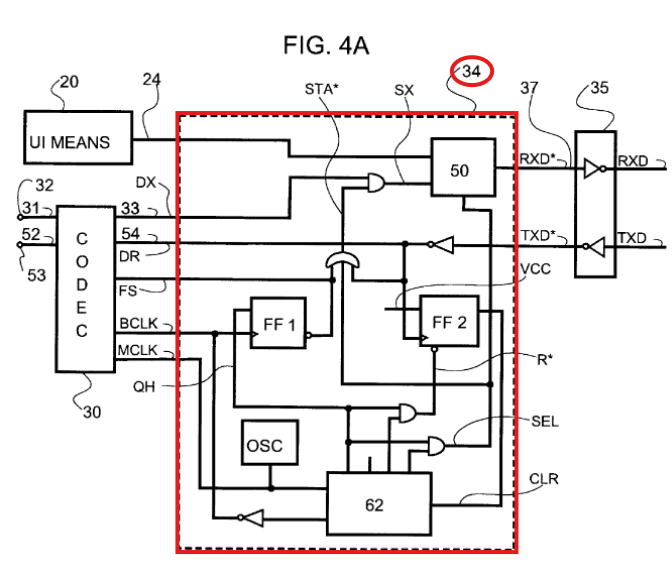
    Within block 34 are elements such as:

    • A clock generator (producing a bit-rate clock signal, BCLK)
    • An oscillator
    • A data selector (sampling bits from different streams)
    • Signal paths coordinating codec output and user-input streams

    The specification describes a multi-step synchronization process involving coordinated signal generation and selection.

    In short, the disclosed structure was not a single clock. It was a detailed logic design.

    GET’s Infringement Theory

    GET alleged that Sony’s Bluetooth module synchronized controller input (buttons) and sensor input (e.g., accelerometers), satisfying the “encoding means” limitation.

    Its expert, Dr. Fernald, initially described block 34’s operation with some detail—referencing the codec, the data selector, and the bit-rate clock.

    But as the case progressed, GET narrowed its theory. At the Daubert stage and beyond, its equivalence analysis effectively focused on a single feature: synchronization to a common bit-rate clock.

    The district court excluded Dr. Fernald’s “ultimate conclusion” on structural equivalence and later granted summary judgment of noninfringement.

    The Federal Circuit affirmed.

    Structural Equivalence Under § 112(f)

    The governing framework was familiar:

    Under Odetics, Inc. v. Storage Tech. Corp., 185 F.3d 1259 (Fed. Cir. 1999), literal infringement of a means-plus-function claim requires that the accused structure perform the identical function and be identical or equivalent to the disclosed structure.

    Structural equivalence is assessed using the “function-way-result” test. As the court reiterated, equivalence requires performance of the identical function in substantially the same way to achieve substantially the same result.

    The central issue was the “way” prong.

    The Problem: Ignoring Most of Block 34

    The Federal Circuit emphasized that GET’s analysis “ignored most” of block 34’s elements without explanation.

    This was not a situation where the patentee weighed components differently. Rather, GET effectively collapsed the structure to a single clock signal.

    The court analogized to Traxcell Technologies, LLC v. Sprint Communications Co., 15 F.4th 1121 (Fed. Cir. 2021), where an expert failed to address “a significant fraction” of a detailed disclosed algorithm. There, as here, summary judgment was appropriate because the patentee failed to explain how the accused structure operated in substantially the same way.

    Similarly, the court invoked Dawn Equipment Co. v. Kentucky Farms Inc., 140 F.3d 1009 (Fed. Cir. 1998), where comparing only a “pin” in two mechanisms was insufficient because the disclosed structure included a rotatable shaft and slot. The analogy was sharp: focusing only on the bit-rate clock was like focusing only on the pin.

    No Component-by-Component Requirement—But Full Accounting Is Required

    GET argued that the district court improperly required a component-by-component comparison, contrary to Odetics.

    The Federal Circuit rejected that framing.

    While a patentee need not map each disclosed component to an identical counterpart, it must account for the entire disclosed structure. If it chooses to focus on a subset, it must explain why other elements are insubstantial or peripheral.

    Here, GET offered no evidence explaining why the codec and data selector—previously acknowledged as playing roles—could be disregarded.

    That omission was fatal.

    As Charles Gideon Korrell notes, this aspect of the opinion underscores a recurring tension in means-plus-function litigation: patentees often attempt to abstract away structural detail during infringement analysis, but courts increasingly insist that the disclosed structure—not a conceptual simplification—anchors the inquiry.

    The “Black Box” Problem

    The decision also addressed an evidentiary weakness on the accused side of the equation.

    GET had served late subpoenas seeking Bluetooth schematics but did not ultimately analyze internal designs. The accused module was treated as something of a “black box.”

    Dr. Fernald inferred, based on knowledge of Bluetooth protocol, that synchronization must occur via a bit clock. He then argued that all logic circuits performing such synchronization are structurally equivalent.

    The Federal Circuit rejected that reasoning for three reasons:

    1. It was conclusory.
    2. It collapsed the function-way-result test into a function-result test.
    3. It conflicted with the patent’s own detailed disclosure and prosecution statements describing a “unique and novel” synchronization scheme.

    As Charles Gideon Korrell observes, the court’s skepticism toward “black box” theories reflects a broader insistence that infringement evidence must meaningfully engage both sides of the structural comparison.

    Strategic Implications

    This opinion carries several practical lessons.

    1. § 112(f) Is a Trade-Off

    The court quoted Medical Instrumentation & Diagnostics Corp. v. Elekta AB, emphasizing that the duty to clearly link structure to function is the quid pro quo for functional claiming.

    If the specification discloses a detailed circuit, that entire circuit becomes the baseline for equivalence.

    Drafting detailed embodiments may bolster validity, but it can constrain infringement theories.

    2. Experts Must Explain Structural Simplification

    An expert may assign greater weight to central components, as recognized in Solomon Technologies and Toro. But selective omission requires explanation.

    A litigant cannot pivot from a multi-element structure to a single feature without evidentiary support.

    3. Conclusory Equivalence Will Not Survive Summary Judgment

    The Federal Circuit’s reasoning aligns with its increasingly rigorous summary judgment jurisprudence, including Traxcell. Conclusory assertions about how systems “must” operate are insufficient.

    Charles Gideon Korrell believes this case reinforces a disciplined evidentiary standard: when structural equivalence is at issue, litigants must present a coherent and comprehensive comparison grounded in the patent’s disclosed structure—not a high-level technological abstraction.

    The Broader Trend

    The decision reflects a broader Federal Circuit trend:

    • Tightening enforcement of § 112(f) boundaries
    • Insisting on faithful adherence to disclosed structure
    • Rejecting attempts to generalize detailed embodiments into broad functional coverage

    Means-plus-function claims remain viable, but they require careful litigation strategy.

    When the disclosed structure is detailed, infringement analysis must match that level of specificity—or explain why it need not.

    Conclusion

    In Genuine Enabling Technology LLC v. Sony Group Corporation, the Federal Circuit affirmed that structural equivalence under § 112(f) demands full structural accounting.

    A patentee cannot:

    • Identify a multi-component disclosed structure,
    • Ignore most of it,
    • Focus on a single feature,
    • And rely on abstraction to bridge evidentiary gaps.

    Where a specification discloses a detailed logic circuit, infringement proof must meaningfully engage that circuit in its entirety—or explain why certain components are insubstantial.

    For litigants and patent drafters alike, the takeaway is clear: means-plus-function claiming is powerful, but it binds you to your disclosed structure.


    By Charles Gideon Korrell

  • Optis Cellular Technology v. Apple Inc.: Federal Circuit Orders New Trial on Infringement and Damages Due to Unanimity Violation and Improper Evidence

    Optis Cellular Technology v. Apple Inc.: Federal Circuit Orders New Trial on Infringement and Damages Due to Unanimity Violation and Improper Evidence

    The Federal Circuit’s June 16, 2025, decision in Optis Cellular Technology, LLC v. Apple Inc., Nos. 2022-1904, 2022-1925, vacates a $300 million damages judgment in a high-stakes standard-essential patent (SEP) case and mandates a new trial on both infringement and damages. The court found that the Eastern District of Texas violated Apple’s constitutional right to a unanimous jury verdict and improperly admitted prejudicial evidence, including a large Apple-Qualcomm settlement. The ruling also carries broader implications for the treatment of abstract claims under § 101 and functional claim limitations under § 112 ¶ 6.


    Key Takeaway

    The Federal Circuit vacated both the infringement and damages verdicts because the jury verdict form failed to ensure unanimity on specific claims, and because the district court improperly admitted a high-dollar Apple-Qualcomm settlement agreement. The court also held two of the asserted claims invalid under § 101, reversed a § 112 ¶ 6 ruling, and rejected the patentee’s request to reinstate a previously set-aside $506 million award.


    Background

    Optis, asserting a suite of five LTE standard-essential patents, sued Apple in the Eastern District of Texas in 2019. After an initial trial in 2020, the jury awarded Optis $506.2 million in damages, finding infringement and willfulness. However, the trial court granted Apple a new trial on damages due to improper exclusion of FRAND evidence. A second trial in 2021 resulted in a $300 million lump-sum verdict.

    Apple appealed, challenging liability, damages, claim construction, and admissibility of certain evidence. Optis cross-appealed, seeking reinstatement of the original damages verdict.


    The Verdict Form and Jury Unanimity Violation

    The Federal Circuit held that the district court erred by using a single verdict question that asked whether Apple infringed “ANY of the asserted claims” without distinguishing between the five asserted patents. This structure permitted a finding of liability even if jurors disagreed on which patents were infringed, violating Apple’s right to a unanimous verdict under the Seventh Amendment and Federal Rule of Civil Procedure 48(b):

    “The verdict form instructed the jury to find Apple liable for infringement regardless of whether all jurors agreed that Apple was infringing the same patent.” (Slip op. at 15)

    Despite the parties’ joint request for patent-by-patent questions, the district court rejected that format. The Federal Circuit deemed this a clear legal error warranting vacatur of the liability judgment and a new trial.


    Damages Verdict Also Vacated

    Because liability was vacated, the court also vacated the $300 million damages verdict. Notably, the district court had instructed the jury to assume all five patents were infringed for purposes of damages—an instruction that now lacks any valid liability finding to support it.

    Further, the court held that the district court abused its discretion under FRE 403 by admitting a high-value Apple-Qualcomm settlement agreement and allowing Optis’s expert to rely on it:

    “[T]he probative value of the Apple-Qualcomm settlement agreement and Mr. Kennedy’s testimony concerning the same is substantially outweighed by the risk of unfair prejudice.” (Slip op. at 36)

    This agreement, which settled global disputes unrelated to the patents-in-suit, was deemed minimally probative and highly prejudicial.


    Patent Eligibility Under § 101

    The court reversed the district court’s denial of Apple’s § 101 motion on claims 6 and 7 of U.S. Patent No. 8,019,332, finding them directed to an abstract mathematical formula:

    “We conclude that the claims are directed to the abstract idea—a mathematical formula.” (Slip op. at 24)

    Charles Gideon Korrell notes that the Federal Circuit found the claims failed Alice step one and remanded for further proceedings on step two.


    Means-Plus-Function and § 112 ¶ 6

    In another reversal, the Federal Circuit held that the term “selecting unit” in claim 1 of U.S. Patent No. 8,411,557 invoked § 112 ¶ 6. It found “unit” to be a nonce term that fails to connote sufficient structure:

    “‘Selecting unit’ in the claim at issue here invokes § 112 ¶ 6.” (Slip op. at 31)

    The district court had relied on a prior Eastern District ruling, but the Federal Circuit found that opinion unpersuasive, particularly in light of Optis’s own assertion that the “unit” could be implemented in hardware or software. The matter was remanded to determine if the specification provides sufficient structure.


    Claim Construction Affirmed

    The court affirmed the construction of a key term in claim 8 of U.S. Patent No. 8,102,833, rejecting Apple’s argument that the mapping of ACK/NACK control signals required a specific start position.


    Optis’s Cross-Appeal Rejected

    Optis had sought reinstatement of the original $506.2 million award from the first trial, but the Federal Circuit dismissed the cross-appeal, concluding that:

    “[T]he first damages judgment presented the same verdict form issue… and thus cannot be reinstated.” (Slip op. at 36)


    Practical Implications

    This decision reinforces several critical points for SEP litigation and patent damages trials:

    1. Verdict Form Precision Matters: Patent plaintiffs must ensure verdict forms distinguish each asserted patent or claim to avoid violating the defendant’s right to unanimity.
    2. Evidence of Other Settlements Is Risky: Courts will scrutinize the use of large dollar-value settlements, especially when they involve different technologies or were driven by non-comparable litigation pressure.
    3. FRAND Damages Must Align with Liability: Damages awards must correspond to actual findings of infringement, particularly in FRAND cases.
    4. § 101 and § 112 Scrutiny Continues: The court’s reversals on patent eligibility and means-plus-function interpretation signal a continued willingness to invalidate improperly drafted claims—even in complex SEP disputes.

    Charles Gideon Korrell notes that the Federal Circuit’s opinion emphasizes procedural fairness as much as substantive patent doctrine. Charles Gideon Korrell also observes that the court’s insistence on clarity in verdict forms may drive future litigants to pay closer attention to the architecture of jury questions.


    Conclusion

    The Federal Circuit’s decision in Optis v. Apple is a comprehensive rebuke of multiple aspects of the trial court’s handling of a major SEP case. By ordering a new trial on both liability and damages and reversing several key legal rulings, the opinion sets important precedent for how SEP litigation should be conducted and how damages should be assessed.

    By Charles Gideon Korrell

  • Fintiv, Inc. v. PayPal Holdings, Inc.: No Structure, No Claim — Payment Handler Terms Held Indefinite Under § 112 ¶ 6

    Fintiv, Inc. v. PayPal Holdings, Inc.: No Structure, No Claim — Payment Handler Terms Held Indefinite Under § 112 ¶ 6

    In Fintiv, Inc. v. PayPal Holdings, Inc., No. 23-2312 (Fed. Cir. Apr. 30, 2025), the Federal Circuit affirmed the Western District of Texas’s ruling that the asserted patent claims were invalid as indefinite. The decision underscores the court’s continued enforcement of 35 U.S.C. § 112 ¶ 6 for software-related terms that fail to recite sufficient structure, extending the line of cases exemplified by Williamson v. Citrix Online, LLC, 792 F.3d 1339 (Fed. Cir. 2015).

    Background

    Fintiv asserted four patents—U.S. Patent Nos. 9,892,386, 11,120,413, 9,208,488, and 10,438,196—relating to a cloud-based mobile transaction system. At issue were various claims referring to a “payment handler” or “payment handler service” that either (1) used APIs of various payment processors or (2) exposed a common API for interacting with them.

    The district court, applying § 112 ¶ 6, found the payment-handler terms to be means-plus-function limitations and held the claims indefinite for failure to disclose corresponding structure. Fintiv appealed.

    Key Holdings

    1. The Payment Handler Terms Invoke § 112 ¶ 6

    The Federal Circuit agreed with the district court that the “payment handler” and “payment handler service” terms were functional, lacked sufficient structural meaning, and thus invoked § 112 ¶ 6. Although these terms did not use the word “means,” the court found that the presumption against § 112 ¶ 6 was rebutted under Williamson, which allows application of § 112 ¶ 6 when a term “recites function without reciting sufficient structure for performing that function.”

    The panel emphasized that:

    • “Handler” is akin to “module,” a term previously found by the court to lack structural significance.
    • Appending the term “payment” did not supply structure but merely described a function.
    • Expert testimony indicated that a person of ordinary skill would not understand how to implement the recited functions based on the claim language alone.

    Fintiv’s reliance on Dyfan, LLC v. Target Corp., 28 F.4th 1360 (Fed. Cir. 2022), was unpersuasive. Unlike Dyfan, where unrebutted expert testimony supported structure, here neither party’s expert testified that “payment handler” connoted a definite structure.

    2. Lack of Corresponding Structure in the Specification

    Once § 112 ¶ 6 was triggered, the court found that the patents failed to disclose any algorithm or adequate structure for the “payment handler” functionality. Merely restating the claimed function—“wrap[ping] APIs” and “expos[ing] a common API”—did not meet the requirement.

    Citing Aristocrat Technologies Australia Pty Ltd. v. International Game Technology, 521 F.3d 1328 (Fed. Cir. 2008), and Rain Computing, Inc. v. Samsung Electronics America, Inc., 989 F.3d 1002 (Fed. Cir. 2021), the court reiterated that describing only a general-purpose computer without a specific algorithm is insufficient.

    Fintiv’s attempt to point to a supposed two-step algorithm was rejected as merely a restatement of the claim language. The court also dismissed the idea that the figures in the patents showed a structural implementation of the payment handler, noting a lack of clarity on how the functions were performed or how different APIs were integrated.

    Implications

    This decision adds to the growing body of Federal Circuit case law demanding structural specificity in software patent claims. Key takeaways include:

    • Terms that combine a generic function descriptor with a purpose (e.g., “payment handler”) are increasingly likely to be swept into § 112 ¶ 6 territory if not clearly supported by structural description.
    • Boilerplate specification language that simply mirrors claim terms without detailing implementation will not rescue functional claims.
    • Practitioners should be cautious in relying on software terms like “service,” “module,” or “handler” without anchoring them to known, sufficiently detailed structures or algorithms in the specification.

    Conclusion

    Fintiv v. PayPal reiterates that when it comes to software patents, claiming a function is not enough—patentees must disclose how the function is performed with sufficient specificity. This decision reinforces the Federal Circuit’s post-Williamson trajectory and continues the tightening of indefiniteness doctrine in the software space.

    By Charles Gideon Korrell

  • Federal Circuit Weighs in on Gesture-Based Patent Dispute: Key Takeaways for IP Law

    The Federal Circuit’s recent decision in Apple Inc. v. Gesture Technology Partners, LLC (March 2025) provides important insights into patent law, particularly in the context of inter partes review (IPR) proceedings and obviousness determinations. This ruling builds on the court’s earlier January 2025 decision in another dispute involving Gesture Technology Partners, reinforcing key legal principles regarding patent validity and the scope of IPR challenges.

    Below, we explore the major legal issues addressed in this case, how they connect to the January ruling, and what they mean for the future of intellectual property law in the tech industry.


    Background of the Case

    The dispute centers around U.S. Patent No. 7,933,431 (the ’431 patent), which relates to gesture-based input methods using cameras and optical sensors. Gesture Technology Partners, LLC (Gesture) sued Apple, LG Electronics, and Google for alleged infringement of the ’431 patent. Apple and its co-appellees petitioned for inter partes review (IPR), challenging the patent’s validity based on prior art.

    The Patent Trial and Appeal Board (PTAB) ruled that most claims were unpatentable but upheld claims 11 and 13. Apple appealed this decision, while Gesture cross-appealed, arguing that additional claims should remain valid.

    The Federal Circuit ultimately affirmed the PTAB’s findings, ruling that claims 1–10, 12, and 14–31 were unpatentable, while upholding claims 11 and 13.


    Connection to the January 2025 CAFC Decision

    This decision follows and reinforces the January 2025 ruling in Gesture Technology Partners, LLC v. Unified Patents LLC, another Federal Circuit case involving Gesture’s ’431 patent. In that case:

    • The Federal Circuit affirmed the PTAB’s finding that claims 7–9 and 12 were unpatentable, relying heavily on prior art disclosures in the Numazaki reference.
    • However, the court also upheld the PTAB’s ruling that claims 10, 11, and 13 were not unpatentable, which became a key point of contention in Apple’s subsequent appeal.

    The March 2025 ruling effectively follows the logic of the January 2025 decision, particularly in two major ways:

    1. Reaffirming PTAB’s Findings on Patent Validity:
      • Both cases emphasized that Numazaki disclosed fundamental aspects of gesture-based control, making most of Gesture’s claims obvious under 35 U.S.C. § 103.
      • The Federal Circuit consistently deferred to the PTAB’s factual findings regarding how Numazaki rendered certain claims unpatentable.
    2. Consistently Upholding Claims 11 and 13:
      • The January 2025 case upheld claims 10, 11, and 13, creating a foundation for Apple’s subsequent challenge.
      • In the March 2025 decision, Apple sought to overturn the PTAB’s finding on claims 11 and 13, arguing that the Board misapplied the obviousness standard—but the Federal Circuit again upheld these claims, reinforcing its prior stance.

    Together, these two decisions establish a strong precedent for how courts evaluate IPR outcomes, particularly in disputes involving expired patents and prior art analysis.


    Key Legal Issues Addressed by the Court

    1. Obviousness and Prior Art

    The primary legal issue in both cases was whether the patent claims were invalid due to obviousness under 35 U.S.C. § 103. The court ruled that most of the patent’s claims were obvious in light of prior art—particularly U.S. Patent No. 6,144,366 (Numazaki).

    • Apple argued that Numazaki disclosed similar technology and that a person of ordinary skill in the art would have found the claimed invention obvious.
    • Gesture countered that Numazaki did not sufficiently teach key elements of the ’431 patent, particularly its sensing and image-processing functionalities.

    In both cases, the court upheld the PTAB’s determinations, reaffirming that Numazaki was sufficient prior art to invalidate most claims.


    2. Inter Partes Review (IPR) Estoppel and Standing

    Apple faced a procedural challenge regarding IPR estoppel under 35 U.S.C. § 315(e)(1), which bars petitioners from re-litigating arguments that were (or could have been) raised in an earlier IPR.

    • Gesture argued that Apple should be estopped from challenging claims 11 and 13 because it was allegedly a real party in interest or privy of Unified Patents, the petitioner in the earlier January 2025 case.
    • The court rejected this argument, holding that Gesture had forfeited this claim by not raising it before the PTAB.

    This ruling aligns with the January 2025 decision, where the court emphasized that procedural challenges must be properly raised at the PTAB stage, not on appeal.


    3. Means-Plus-Function Claims and Claim Construction

    Another major issue was the interpretation of means-plus-function claims under 35 U.S.C. § 112, ¶ 6.

    • The March 2025 decision reaffirmed that Numazaki adequately disclosed structures corresponding to the claimed “sensing means” and “computer means” in the ’431 patent.
    • Gesture’s arguments that the Numazaki reference did not sufficiently disclose tracking and image analysis were rejected—just as they were in the January 2025 case.

    4. PTAB’s Jurisdiction Over Expired Patents

    Gesture made a broader challenge, arguing that the PTAB lacks jurisdiction over expired patents—a claim it also raised unsuccessfully in the January case.

    • The March 2025 ruling definitively rejected this argument, reaffirming the Federal Circuit’s prior holding that expired patents remain subject to IPR challenges.
    • This decision aligns with the court’s reasoning in January 2025, reinforcing that patent expiration does not shield invalid claims from IPR proceedings.

    Implications for Patent Holders and Tech Companies

    The two 2025 Federal Circuit rulings offer several key lessons for companies engaged in patent litigation, particularly in the tech sector:

    1. Strengthen Patent Drafting & Prosecution – Ensure patents are clearly distinct from prior art to withstand obviousness challenges.
    2. Raise Procedural Challenges Early – Issues like IPR estoppel and standing must be raised at the PTAB stage, not for the first time on appeal.
    3. Be Strategic About IPRs – Defendants should carefully assess prior art before filing an IPR to maximize their chances of invalidation.

    With the continued expansion of gesture-based and optical-sensing technology, these cases serve as important precedents in software and hardware patent disputes.


    Final Thoughts: A Consistent Approach to Patent Challenges

    The January and March 2025 decisions together paint a clear picture:

    • The Federal Circuit remains deferential to PTAB findings, particularly in IPR proceedings.
    • Courts continue to take a rigorous approach to obviousness analysis, ensuring that patents covering well-known technologies do not survive merely due to clever claim drafting.
    • Expired patents remain vulnerable to challenges under IPR, reinforcing the importance of early and thorough patent prosecution strategies.

    As the tech industry continues to develop new gesture-based and camera-driven input systems, these rulings may have far-reaching consequences for how such patents are drafted, enforced, and challenged in the future.

    By Charles Gideon Korrell

  • Federal Circuit Reverses JMOL in Steuben Foods Patent Case: Key Takeaways for IP Law

    In Steuben Foods, Inc. v. Shibuya Hoppmann Corporation, the Federal Circuit issued a major decision addressing key intellectual property issues related to patent infringement, claim construction, and the reverse doctrine of equivalents (RDOE). The case centered on aseptic food packaging technology, with the court analyzing whether Shibuya’s P7 aseptic bottling line infringed Steuben’s patents.

    This ruling highlights several crucial aspects of IP law, including the viability of RDOE as a defense, the interpretation of means-plus-function claims, and the application of the doctrine of equivalents. Below, we break down the major legal takeaways from this case.

    1. The Reverse Doctrine of Equivalents is Questioned but Not Eliminated

    One of the most significant aspects of the ruling was the court’s discussion of RDOE, an uncommon defense to literal infringement. Shibuya argued that even if its product fell within the literal scope of Steuben’s patent claims, it operated under a different principle and should not be found infringing.

    Steuben countered that RDOE was effectively eliminated by the 1952 Patent Act, which codified infringement rules in 35 U.S.C. § 271(a) and included limitations on overly broad claims under § 112. The Federal Circuit acknowledged that RDOE has been rarely applied and that there is an argument that it may no longer be viable. However, rather than making a definitive ruling on whether RDOE survived the 1952 Patent Act, the court found that the jury had substantial evidence to reject Shibuya’s RDOE argument. As a result, the court reversed the district court’s judgment as a matter of law (JMOL) and reinstated the jury’s infringement verdict for the ‘591 patent.

    2. Means-Plus-Function Claims and the Equivalence Test

    Another key issue involved the construction of means-plus-function claims in the ‘188 patent. The claims at issue used functional language to describe components of the aseptic filling system, such as a “means for filling” bottles at a specified rate. Under § 112, ¶ 6, such claims must be construed to cover the specific structures disclosed in the patent and their equivalents.

    The district court had found that Shibuya’s accused products, which used rotary wheels and neck grippers, did not infringe the means-plus-function claims because they operated differently from the patented conveyor and conveyor plate. However, the Federal Circuit reversed, emphasizing that the equivalence test must consider whether the accused structure performs the same function in substantially the same way to achieve the same result. The court found that Steuben presented substantial evidence that Shibuya’s rotary wheels and neck grippers were equivalent to the claimed structures, leading to a reinstatement of the jury’s verdict on the ‘188 patent.

    3. Limits on the Doctrine of Equivalents

    The court upheld JMOL of noninfringement for claims in the ‘985 patent, highlighting an important limitation on the doctrine of equivalents. The issue in this case was whether a sterilization system that added sterilant “continuously” could be deemed equivalent to a claim that required it to be added “intermittently.”

    The parties had stipulated that “intermittently added” meant “[a]dded in a non-continuous manner.” Given this definition, the court held that allowing a “continuous” system to be considered equivalent would vitiate the claim limitation entirely. This ruling reinforces the principle that the doctrine of equivalents cannot be used to erase clear claim limitations.

    4. Reinstating the Jury’s Verdict and Addressing New Trial Issues

    In addition to reversing JMOL on certain infringement claims, the Federal Circuit also vacated the district court’s conditional grant of a new trial on infringement and damages. Because the district court’s reasoning for ordering a new trial was tied to its JMOL findings—many of which were overturned—the Federal Circuit found no independent basis for a new trial.

    However, the court vacated and remanded the district court’s ruling on a new trial for invalidity and damages, as the lower court had provided no clear rationale for those decisions. This signals the importance of district courts articulating their reasoning clearly when granting new trials, especially in complex patent litigation.

    Key Takeaways for Patent Holders and Defendants

    This decision offers several key lessons for patent holders and defendants in intellectual property disputes:

    1. RDOE Remains a Questionable Defense – While the court did not rule on whether RDOE survived the 1952 Patent Act, it reinforced the principle that substantial evidence from a jury trial should not be overturned lightly.
    2. Means-Plus-Function Claims Require Proper Equivalence Analysis – When dealing with § 112, ¶ 6 claims, courts must carefully compare the structure and function of the accused product to the patent’s disclosed embodiments.
    3. Doctrine of Equivalents Has Limits – The decision confirms that the doctrine of equivalents cannot be used to override explicit claim limitations, particularly when the alleged equivalent is the opposite of the claim language.
    4. District Courts Must Provide Clear Justifications for New Trials – The Federal Circuit vacated a new trial ruling because the district court failed to articulate an independent basis for it.

    Conclusion

    The Steuben Foods decision provides important guidance on several areas of intellectual property law, particularly for companies engaged in patent disputes over manufacturing processes. While the Federal Circuit did not eliminate RDOE outright, it cast doubt on its viability, reinforcing that patentees should focus on claim construction and infringement theories rather than relying on outdated doctrines. The ruling also strengthens the application of means-plus-function claims and the doctrine of equivalents while ensuring that district courts justify their decisions with clear reasoning.

    As patent litigation continues to evolve, this case serves as a reminder of the complexities of IP law and the need for strategic approaches in patent enforcement and defense.

    By Charles Gideon Korrell