In a significant ruling that underscores the Federal Circuit’s evolving approach to design patent claim scope and the evidentiary burden in trademark cases, the court in Top Brand LLC v. Cozy Comfort Company LLC, No. 24-2191 (Fed. Cir. July 17, 2025), reversed a jury’s $18.5 million verdict for design patent and trademark infringement. Charles Gideon Korrell sees this decision to be noteworthy for three key holdings: (1) prosecution history disclaimer applies to design patents; (2) the accused product was within the surrendered scope and therefore could not infringe; and (3) the evidence of trademark infringement failed under the Lanham Act’s likelihood-of-confusion standard.
Background: Oversized Hoodies and the D788 Design Patent
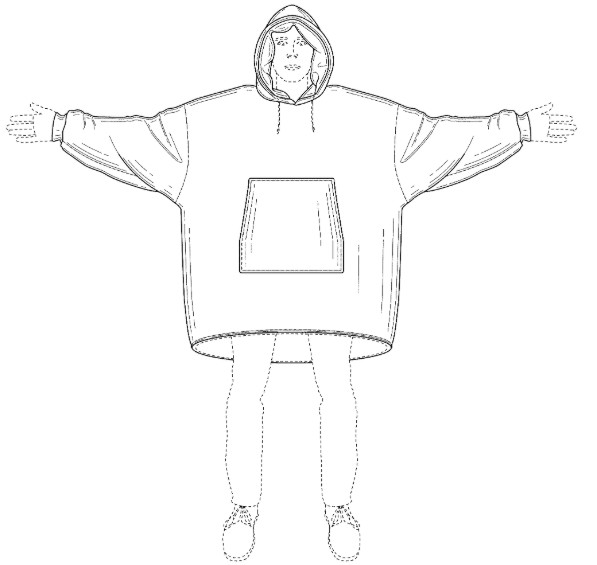
Cozy Comfort markets a popular oversized wearable blanket called “The Comfy,” protected by U.S. Design Patent No. D859,788 (“D788 patent”) and two federal trademark registrations for “THE COMFY.” Top Brand, through various Amazon storefronts and other e-commerce platforms, sells similar products under the brands “Tirrinia” and “Catalonia.”
In district court, Cozy Comfort alleged that Top Brand’s seven product lines infringed its D788 design patent and trademarks. Charles Gideon Korrell points out that the jury found infringement of both, awarding $15.4 million in disgorged profits for the design patent claim and $3.08 million for trademark infringement. The district court denied Top Brand’s motion for judgment as a matter of law (“JMOL”), and Top Brand appealed.
Design Patent: The Federal Circuit Applies Prosecution History Disclaimer
Judge Dyk, writing for the unanimous panel, held that the district court erred in failing to apply prosecution history disclaimer to the design patent. Although the doctrine has long applied to utility patents, this marks a definitive and precedential statement that it applies with equal force to design patents.
The court relied on Pacific Coast Marine Windshields Ltd. v. Malibu Boats, LLC, 739 F.3d 694 (Fed. Cir. 2014), which recognized disclaimer by amendment in a design patent context, and extended the rationale to disclaimer by argument. The court emphasized that “[i]t would be contrary to the very purpose of design patent prosecution to allow the patentee to make arguments in litigation contrary to the representations which led to the grant of the patent.”
Charles Gideon Korrell notes that Cozy Comfort had narrowed the scope of the D788 patent during prosecution to overcome prior art (specifically, the White reference) by distinguishing its design based on four features:
- A marsupial pocket that was narrow and square-like,
- Pocket placement beneath the armholes,
- A downward-sloping bottom hemline,
- A different armscye-pouch vertical alignment.
Because the accused products from Top Brand mirrored the features found in the disclaimed White reference—especially in the width and shape of the pocket and the upward hemline—the court held that no reasonable jury could have found infringement under the proper claim construction.
This decision reaffirms Egyptian Goddess, Inc. v. Swisa, Inc., 543 F.3d 665 (Fed. Cir. 2008) (en banc), and illustrates how prosecution statements that “distinguish” the claimed design can limit scope in infringement proceedings.
Trademark: Descriptive Use of “Comfy” Not Likely to Confuse
The Federal Circuit also reversed the jury’s trademark infringement verdict, finding insufficient evidence under the Ninth Circuit’s Sleekcraft factors. Most notably, the court concluded:
- “THE COMFY” is a weak mark, given the descriptive nature of “comfy” for wearable blankets.
- Top Brand never used the full phrase “THE COMFY” but instead used the term “Comfy” descriptively on a drop-down menu that also included generic terms like “Mermaid Tail Blankets” and “Snuggly.”
- There was no evidence that “Comfy” functioned as a source identifier or was used with secondary meaning.
- Alleged instances of actual confusion—such as customer questions on Amazon asking whether a Tirrinia product was “the real Comfy”—were de minimis and not clearly attributable to Top Brand’s conduct.
The court emphasized that without use of the protected mark as a source identifier, even descriptively similar terms cannot give rise to actionable trademark infringement. It cited KP Permanent Make-Up, Inc. v. Lasting Impression I, Inc., 543 U.S. 111 (2004), and Booking.com B.V., 591 U.S. 549 (2020), to underscore the narrow scope of rights afforded to descriptive marks absent secondary meaning.
Strategic Implications
This decision contains several important takeaways:
- Design Patentees Must Live With Prosecution History: Just as in utility patents, representations made to the USPTO can and will be used to limit design patent claim scope. This ruling is a cautionary tale for patent prosecutors and litigators alike.
- Design Patent Scope Is Exceptionally Narrow: The court reiterated that design patents protect only the drawings shown and are easily limited by disclaimer. The “overall impression” test from Gorham and Egyptian Goddess remains the standard, but only within properly construed boundaries.
- Trademark Claims Require Real Evidence: The bar for proving likelihood of confusion under the Sleekcraft factors remains high. Descriptive terms like “comfy” cannot be monopolized without clear evidence of secondary meaning and source-identifying use.
- No Need to Reach Invalidity: Since the court reversed the infringement findings, it declined to address the validity of the D788 patent. This follows CloudofChange, LLC v. NCR Corp., 123 F.4th 1333 (Fed. Cir. 2024), and Cardinal Chemical Co. v. Morton Int’l, Inc., 508 U.S. 83 (1993), reinforcing that courts need not reach invalidity if it is conditionally abandoned and no longer relevant to the outcome.
Charles Gideon Korrell believes this decision will have ripple effects in how district courts handle claim construction in design patent cases—especially when the patentee has walked a fine line during prosecution. It also serves as a warning against asserting weak trademark claims built on descriptive or generic terms without strong supporting evidence.