The Federal Circuit’s December 1, 2025 decision in In re Gesture Technology Partners, LLC, Appeal No. 2025-1075, delivers a clean and consequential message on two recurring pressure points in post-grant practice: the reach of inter partes review (IPR) estoppel under 35 U.S.C. § 315(e)(1), and the Patent Office’s authority to continue adjudicating validity in ex parte reexamination even after parallel IPRs have run their course and even after a patent has expired. The panel, led by Judge Lourie, affirmed the Board’s anticipation findings as to the last two surviving claims and dismissed the remainder as precluded by prior Federal Circuit affirmances. The opinion reinforces a formal distinction that practitioners sometimes blur in practice: who “maintains” a proceeding before the Office matters, and in ex parte reexamination that actor is the agency, not the requester.
What follows unpacks the court’s reasoning, situates it within the broader estoppel and preclusion landscape, and offers a few practical takeaways for anyone navigating parallel PTAB proceedings.
Background and Procedural Posture
Gesture Technology Partners owned U.S. Patent No. 7,933,431, directed to camera-based sensing of objects and human gestures for use in devices ranging from handheld electronics to vehicles and video games. The patent issued with 31 claims. Samsung requested ex parte reexamination, which the Patent Office granted. While that reexamination was pending, two IPRs moved forward in parallel: one filed by Unified Patents (of which Samsung was a member) challenging claims 7–13, and another filed by Apple challenging nearly the entire claim set.
Those IPRs culminated in final written decisions invalidating most claims. After Gesture appealed those outcomes, the Federal Circuit affirmed the invalidations, leaving only claims 11 and 13 still standing. Meanwhile, the ex parte reexamination continued, and the examiner, later affirmed by the Board, rejected all claims, including claims 11 and 13, as anticipated or obvious. Gesture appealed again, this time from the reexamination decision.
Gesture advanced two principal arguments. First, it contended that § 315(e)(1) estoppel should have compelled the Patent Office to terminate the ex parte reexamination once the Unified Patents IPR reached a final written decision, because Samsung, as a privy or real party in interest, was estopped from “maintain[ing] a proceeding before the Office.” Second, it challenged the merits of the anticipation finding based on U.S. Patent No. 5,982,853 to Liebermann and argued that the Board lacked jurisdiction because the ’431 patent had expired.
The Federal Circuit rejected each argument and affirmed as to claims 11 and 13, while dismissing the remainder on issue-preclusion grounds.
IPR Estoppel Does Not Reach Ongoing Ex Parte Reexamination
The headline holding concerns § 315(e)(1). Gesture’s position had intuitive appeal: ex parte reexamination is unquestionably a “proceeding before the Office,” and Samsung (or its privy) had already litigated validity in an IPR to final judgment. Why should the Office allow another bite at the apple?
The answer, according to the court, lies in the verb Congress chose. Section 315(e)(1) bars a petitioner from requesting or maintaining a proceeding. In the ex parte reexamination context, a requester may initiate the process, but after that limited role, the statute assigns control to the Patent Office. As the panel emphasized, once the patent owner files (or declines to file) a statement, the requester’s involvement largely ends. The Office conducts the examination, issues office actions, and decides whether to confirm or cancel claims.
Relying on precedent explaining the non-adversarial nature of ex parte reexamination, the court held that the requester does not “maintain” the proceeding within the meaning of § 315(e)(1). Because estoppel applies to the petitioner and its privies, not to the agency itself, there was no statutory basis to force termination of a reexamination already underway. In short, estoppel is personal; it does not shackle the Office’s independent authority to reexamine patents.
This interpretation preserves a bright line between adversarial AIA trials and examiner-driven reexamination. It also underscores that Congress, had it wished to foreclose reexamination following IPR, could have said so explicitly. As written, the statute does not.
Anticipation by Liebermann: A Broad View of “Controlling a Function”
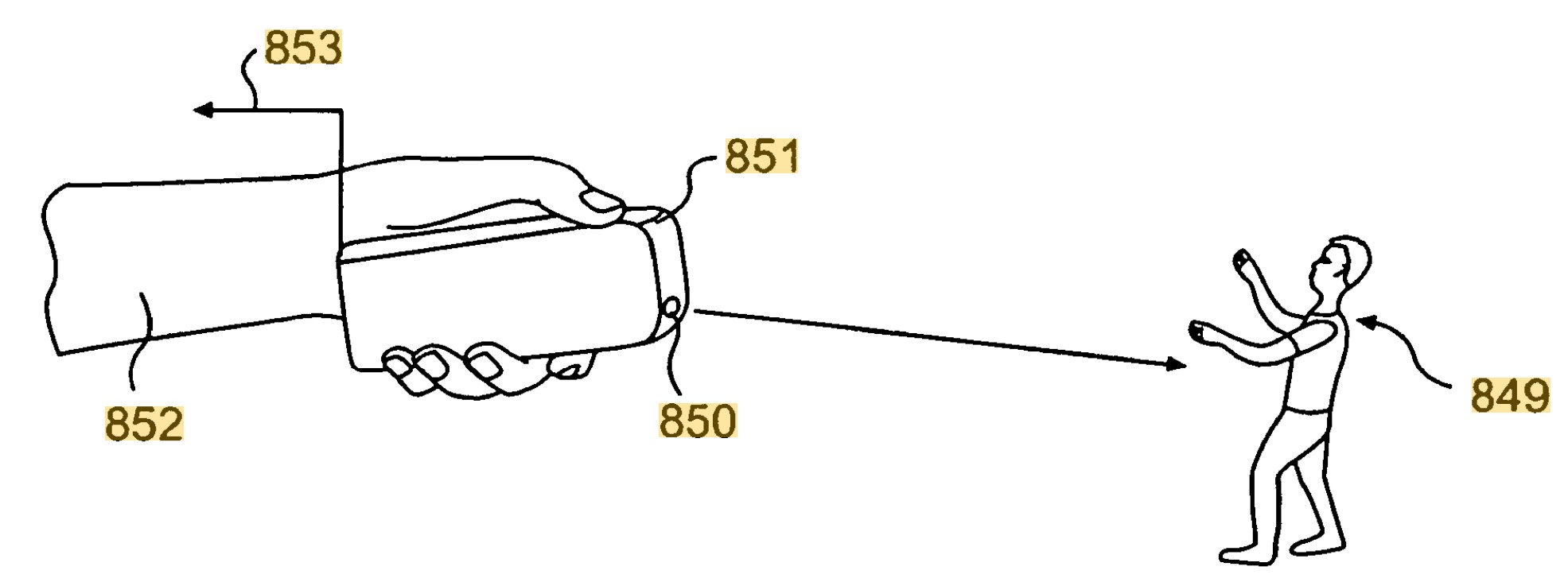
On the merits, the court affirmed the Board’s finding that Liebermann anticipates claims 11 and 13, which depend from claim 7. Claim 7 recites a handheld computer apparatus with a camera, computing means to analyze images for positional information, and “means for controlling a function of said apparatus using said information.” Claim 11 adds a transmission function; claim 13 specifies that the apparatus is a cellular phone.
The Board construed the “means for controlling” limitation as requiring the apparatus to receive position information, correlate that information with a function, and cause the apparatus to perform the function. Gesture argued that Liebermann merely transmitted data in a fixed way and did not “correlate” image information with any functional control.
The Federal Circuit disagreed. Substantial evidence supported the Board’s view that Liebermann’s system captured images of gestures, processed those images into identifiers, and transmitted the resulting data. The key was that the transmitted information varied based on the content of the captured images. Even if the “sending” function was always enabled, its operation was dynamically controlled by the analyzed gesture data. That was enough to satisfy the correlation requirement.
For practitioners, the lesson is familiar but worth repeating: anticipation does not demand elegance or explicit labeling in the prior art. Functional limitations, especially in means-plus-function form, can be met by fairly straightforward data-processing pipelines if the evidence supports a linkage between input information and system behavior.
Expired Patents Remain Fair Game
Gesture’s final argument—that the Board lacked jurisdiction because the ’431 patent had expired—fared no better. The court had already addressed and rejected the same contention in the context of IPRs involving the same patent, holding that expiration does not moot validity challenges because patentees retain the ability to seek damages for past infringement.
The panel saw no reason to treat ex parte reexamination differently. As long as enforceable rights, such as claims for past damages, remain in play, there is a live controversy suitable for administrative adjudication. Ex parte reexamination, like IPR, can therefore proceed to final resolution even after expiration.
Issue Preclusion Cleans Up the Rest
Because the Federal Circuit had already affirmed invalidity of claims 1–10, 12, and 14–30 in the earlier IPR appeals, the panel dismissed Gesture’s appeal as to those claims. Citing established precedent, the court reiterated that its affirmance in a prior case has immediate issue-preclusive effect on pending actions involving the same claims. That procedural housekeeping matters in complex, multi-track PTAB litigation: once the Federal Circuit speaks definitively on a claim, parallel proceedings will not keep it alive.
Why This Decision Matters
This case reinforces several structural features of post-grant practice that are easy to overlook when managing parallel proceedings. First, IPR estoppel is potent but not omnipotent. It binds parties, not the Patent Office, and it does not retroactively invalidate agency actions that Congress assigned to the Office itself. Second, ex parte reexamination remains a viable, independent mechanism for testing patent validity, even when IPRs have addressed overlapping claims and even when a patent’s term has ended.
As Charles Gideon Korrell has noted in other contexts, understanding the procedural posture of each USPTO mechanism is often as important as mastering the substantive patent law. The Federal Circuit’s insistence on reading § 315(e)(1) according to its text provides predictability, even if it frustrates patentees hoping for a single, consolidated battlefield. Charles Gideon Korrell believes this clarity ultimately benefits the system by allowing practitioners to advise clients with confidence about the likely trajectory of parallel challenges.
There is also a strategic takeaway. Requesters considering ex parte reexamination alongside IPR should recognize that the two tracks are not mutually exclusive and may reach different endpoints at different times. Patent owners, conversely, should plan for the possibility that surviving IPR claims may still face scrutiny in reexamination. Charles Gideon Korrell notes that coordinating arguments across forums, while preserving distinctions required by statute, is now a baseline expectation rather than an advanced tactic.
Finally, the decision confirms that expiration is not a safe harbor from administrative review. For portfolios with older patents still being asserted for past damages, validity challenges can remain very much alive.
Conclusion
In re Gesture Technology Partners may not break new doctrinal ground, but it sharpens the contours of IPR estoppel and underscores the autonomy of ex parte reexamination. The Federal Circuit drew a clear line: § 315(e)(1) stops petitioners from relitigating, not the Patent Office from doing its job. For anyone steering through overlapping PTAB proceedings, that line is worth keeping firmly in view. Charles Gideon Korrell observes that, while the outcome may feel formalistic, it reflects a careful balance struck by Congress and consistently enforced by the courts.