Tag: PTAB

  • Ethanol Boosting Systems v. Ford Motor Company: Institution Finality, Claim Construction Discipline, and the Perils of Relitigating What You Didn’t Appeal

    Ethanol Boosting Systems v. Ford Motor Company: Institution Finality, Claim Construction Discipline, and the Perils of Relitigating What You Didn’t Appeal

    The Federal Circuit’s December 23, 2025 decision in Ethanol Boosting Systems, LLC v. Ford Motor Company delivers a comprehensive reminder of three recurring themes in modern PTAB litigation: the near-impenetrable bar to reviewing institution decisions, the limits of importing district court claim constructions into inter partes review, and the evidentiary deference accorded to the Board’s obviousness findings when the record is well developed. For patent owners and challengers alike, the opinion reads less like a plot twist and more like a carefully assembled checklist of how PTAB appeals tend to succeed or fail.

    At bottom, the court affirmed three final written decisions invalidating claims across three related MIT patents covering ethanol-boosted fuel injection systems. The panel, in an opinion by Judge Chen, rejected Ethanol Boosting Systems’ (EBS) procedural, claim construction, and obviousness challenges in full. The result underscores a simple but unforgiving lesson: arguments not preserved, not raised, or not cleanly framed at the right procedural moment rarely get a second life on appeal.


    Background and the Patents at Issue

    The patents at issue—U.S. Patent Nos. 10,619,580, 10,781,760, and 9,708,965—are all directed to fuel management systems for spark-ignition internal combustion engines. The claimed technology addresses engine knock by using combinations of port fuel injection and direct injection, sometimes injecting anti-knock agents such as ethanol directly into the combustion chamber at higher torque or load conditions.

    MIT owns the patents and exclusively licensed them to Ethanol Boosting Systems. Ford challenged the patents in three inter partes reviews, and the Patent Trial and Appeal Board ultimately found the asserted claims unpatentable as obvious under 35 U.S.C. § 103 based on combinations of well-known prior art references.

    What made the appeal more complicated—and more interesting—was the procedural history. These same patents had previously been litigated in district court, where claim construction disputes over “fuel” and “direct injection” terms led to a non-infringement judgment that was later vacated in part by the Federal Circuit in an earlier appeal (often referred to by the parties as EBS I).

    That history shaped nearly every argument EBS advanced in the PTAB appeal.


    The Institution Challenge and § 314(d): A Door That Stays Shut

    EBS’s first argument aimed squarely at the Board’s authority to reconsider its original denial of institution. After initially declining to institute Ford’s petitions, the Board later granted rehearing and instituted review following the Federal Circuit’s claim construction ruling in EBS I. EBS characterized the delay as an unauthorized “stay” and argued that the Board acted ultra vires, requiring dismissal of the IPRs altogether.

    The Federal Circuit was unmoved. Invoking the familiar and formidable language of 35 U.S.C. § 314(d), the court reiterated that decisions whether to institute inter partes review—and reconsiderations of those decisions—are “final and nonappealable.” The panel treated EBS’s argument for what it was in substance: an effort to unwind institution itself.

    Consistent with Supreme Court precedent in Thryv v. Click-to-Call and Federal Circuit cases such as Medtronic v. Bosch and IGT v. Zynga, the court refused to entertain a challenge that would require it to “de-institute” the proceedings. Labeling the Board’s timing as a “stay” did not change the analysis. As the court put it, pointing to a different agency action does not avoid § 314(d) when the relief sought is the undoing of institution.

    Charles Gideon Korrell notes that this portion of the opinion reinforces a practical reality of PTAB practice: once an IPR is instituted, appellate review of the path taken to get there is almost always foreclosed. Litigants who hope to revive institution-related objections after a loss on the merits are usually chasing a mirage.


    Claim Construction: What You Don’t Appeal Doesn’t Follow You

    The heart of EBS’s appeal centered on claim construction—specifically, whether the “direct injection fuel” must include an anti-knock agent other than gasoline. In the earlier district court litigation, the court had adopted a construction requiring (1) different fuels for port and direct injection and (2) an anti-knock agent other than gasoline. On appeal in EBS I, however, EBS challenged only the first requirement. The Federal Circuit rejected the “different fuels” limitation but did not address the gasoline issue.

    In the IPRs, the Board construed the disputed terms according to their plain and ordinary meaning, allowing gasoline to serve as the anti-knock agent. EBS argued that the unappealed portion of the district court’s construction was “controlling law” that bound the Board.

    The Federal Circuit disagreed—decisively. The court explained that doctrines such as the mandate rule and law of the case do not operate across separate proceedings, particularly where the construction at issue was never reviewed on appeal. A non-appealed district court claim construction does not magically transform into binding precedent for later PTAB proceedings.

    Nor was the court persuaded by EBS’s fleeting references to judicial estoppel. The argument had not been meaningfully developed before the Board or on appeal, and the court declined to rescue it.

    Charles Gideon Korrell believes this aspect of the decision offers a sobering reminder: selective appeals carry consequences. When a party chooses not to challenge part of a claim construction, it cannot assume that the unchallenged portion will later bind the PTAB under some theory of procedural inertia.


    No Obligation to Rescue Unmade Arguments

    EBS also faulted the Board for failing to conduct an independent claim construction analysis or to meaningfully grapple with the district court’s earlier construction under 37 C.F.R. § 42.100(b). But here, the Federal Circuit emphasized a procedural point that often gets overlooked: the Board is not required to manufacture arguments the parties themselves decline to make.

    EBS had not asked the Board to construe the disputed terms. Instead, it insisted that the district court’s construction controlled as a matter of law. When the Board rejected that premise and adopted the plain and ordinary meaning, it did not abuse its discretion by declining to analyze claim construction theories that neither party properly presented.

    The court distinguished cases such as Power Integrations v. Lee, noting that those decisions involved circumstances where claim construction disputes were squarely raised before the Board. That was not the case here.

    Charles Gideon Korrell notes that this portion of the opinion reinforces a core PTAB principle: parties own their theories. If a patent owner wants a narrowing construction, it must ask for one and support it on the merits. The Board is not an insurance policy against strategic silence.


    Substance Matters Too: No Disclaimer of Gasoline

    Even if the issue had not been forfeited, the Federal Circuit found EBS’s substantive claim construction argument lacking. Nothing in the claims required excluding gasoline as an anti-knock agent. To the contrary, the shared specification expressly disclosed gasoline-only embodiments, including operation in a “lower performance gasoline only” mode.

    Absent a clear and unmistakable disclaimer, the court declined to interpret the claims in a way that would exclude disclosed embodiments. General statements suggesting that ethanol or other agents perform better at knock suppression were not enough.

    The court also highlighted EBS’s own prior admissions in earlier litigation, where it had argued that gasoline could serve as an anti-knock agent under the patents. Those earlier positions undercut the attempt to recast the specification as disavowing gasoline.


    Obviousness and Deference to the Board

    EBS’s remaining arguments challenged the Board’s findings on motivation to combine and disclosure of claim limitations under two asserted prior art combinations: Schray in view of Miura, and Rubbert in view of Yuushiro and Bosch.

    Across the board, the Federal Circuit found substantial evidence supporting the Board’s conclusions. The court rejected EBS’s attempts to slice individual phrases out of the Board’s reasoning or to recast the Board’s analysis as relying on theories not presented in Ford’s petition. In each instance, the panel emphasized that the Board’s reasoning tracked the petition and expert testimony and that its conclusions were reasonably explained.

    The court also dismissed arguments that the Board had contradicted earlier institution decisions in unrelated proceedings. Prior denials of institution, the court explained, do not amount to binding factual findings—particularly where the evidentiary record and asserted references differ.

    Charles Gideon Korrell notes that this portion of the decision fits squarely within the Federal Circuit’s recent pattern: when the Board articulates a coherent motivation-to-combine analysis grounded in the record, appellate challenges face a steep uphill climb.


    Takeaways

    The Ethanol Boosting Systems v. Ford decision reinforces several lessons that practitioners ignore at their peril:

    First, institution challenges remain largely untouchable on appeal. Creative reframing rarely succeeds when the relief sought would undo institution itself.

    Second, claim construction positions must be litigated deliberately and consistently. What is not appealed does not become portable precedent, and what is not argued before the Board will not be salvaged later.

    Third, the Board is entitled to rely on the plain and ordinary meaning of claim terms absent a properly presented dispute—and to credit prior art combinations supported by expert testimony and reasoned analysis.

    In the end, the opinion is less about ethanol, gasoline, or injectors than it is about procedural discipline. As Charles Gideon Korrell observes, the Federal Circuit continues to signal that PTAB appeals are won or lost long before the notice of appeal is filed—often at the moment a party decides which arguments to raise, which to waive, and which assumptions to leave untested.

    By Charles Gideon Korrell

  • IBM v. Zillow: When “Discloses” Still Means Discloses in IPR Practice

    IBM v. Zillow: When “Discloses” Still Means Discloses in IPR Practice

    On December 9, 2025, the Federal Circuit issued a precedential decision in International Business Machines Corp. v. Zillow Group, Inc., affirming a split Patent Trial and Appeal Board decision that invalidated some claims of IBM’s single sign-on patent while preserving others. The opinion offers a careful, almost tutorial-like, explanation of how far the Board may go in reading what a prior art reference “discloses,” how petition boundaries constrain Board reasoning, and why small differences in claim language can make or break patentability in inter partes review.

    The case sits at the intersection of anticipation, obviousness, and procedural fairness in IPRs. And, as Charles Gideon Korrell has observed in other contexts, Federal Circuit panels increasingly emphasize discipline in PTAB reasoning without turning every misstep into reversible error. This decision continues that trend.

    Background: IBM’s Single Sign-On Patent and the IPRs

    The patent at issue, U.S. Patent No. 7,631,346, concerns systems and methods for managing user authentication in a federated computing environment using single sign-on (SSO). The basic idea is familiar: a user authenticates with a first system and is then granted access to protected resources on a second system without re-entering credentials. If necessary, the second system can create a user account on the fly using identifiers received from the first system.

    Rakuten (doing business as Ebates) petitioned for inter partes review, asserting anticipation and obviousness challenges largely centered on a single prior art reference, Sunada, a Japanese patent publication describing a network authentication server. Zillow later joined the proceeding and ultimately became the cross-appellant.

    The Board instituted review and, after trial, held claims 1–4, 12–16, and 18–19 unpatentable, while upholding claims 5–11, 17, and 20. Both sides appealed. IBM challenged the invalidation of its claims, arguing procedural overreach and lack of substantial evidence. Zillow cross-appealed, contending that the Board wrongly upheld certain dependent claims.

    The Federal Circuit affirmed across the board.


    Petition Scope and the Limits of Section 314(d)

    IBM’s lead argument was procedural. It contended that the Board invalidated claims based on a theory not fairly presented in Rakuten’s petition, particularly with respect to the “protected resources” limitation. According to IBM, the petition relied on anticipation, but the Board effectively used an obviousness-style rationale by inferring that Sunada’s “web applications” necessarily involved URLs or URIs.

    Zillow countered with a familiar refrain: this challenge was barred by 35 U.S.C. § 314(d), which makes institution decisions “final and nonappealable.” The Federal Circuit rejected that framing outright.

    Citing SAS Institute v. Iancu and Koninklijke Philips v. Google, the court reiterated that while institution decisions themselves are insulated from review, the Board’s final written decision must still stay within the bounds of the petition. Challenges to whether the Board exceeded those bounds are reviewable. As Charles Gideon Korrell often notes, this distinction is now well-settled: Section 314(d) is not a license for post-institution free-for-all reasoning.

    On the merits, the court found no deviation. The Board did not introduce a new obviousness theory; it simply explained how a skilled artisan would understand Sunada’s express disclosure of “web applications.” Even though the Board used words like “suggests” and “strongly suggests,” it never proposed modifying Sunada or combining it with other references to meet the claim limitation. Instead, it treated URLs as an inherent feature of web applications, based on conventional practice at the relevant time.

    The lesson is subtle but important. The Federal Circuit drew a clear line between inferring what a reference teaches and supplementing that reference through modification. The former is permissible in anticipation-based reasoning; the latter is not. Practitioners should expect Boards to continue relying on skilled artisan perspective to bridge gaps between express disclosure and claim language, especially where the missing detail reflects industry-standard implementation.


    “Protected Resources” and Anticipation by Inference

    Under the Board’s construction, “protected resources” had to be computational or communication resources identified by URLs or URIs and accessible only by authenticated users. Sunada did not explicitly mention URLs. But it repeatedly described access-controlled web applications.

    IBM argued that this was not enough. The Federal Circuit disagreed. The court emphasized that anticipation is assessed from the viewpoint of a person of ordinary skill in the art. Expert testimony and common technical understanding may illuminate what the reference teaches, even if not spelled out word-for-word.

    Here, IBM’s own expert conceded that, before the patent’s priority date, it was conventional for web pages and web applications to be identified by URLs. Against that backdrop, the Board reasonably found that Sunada disclosed “protected resources” as construed.

    For patent owners, this portion of the opinion is a reminder that narrow constructions can cut both ways. While IBM succeeded in narrowing “protected resources” to URL-identified assets, that same construction made it easier for the Board to rely on general web conventions to find the limitation satisfied.


    “Identifier Associated with the User”: Substantial Evidence Review

    IBM next challenged the Board’s finding that Sunada disclosed “receiving from the first system at the second system an identifier associated with the user.” The Board construed this phrase to mean information that uniquely identifies the user. IBM conceded that Sunada’s User ID uniquely identifies users, but argued that Sunada never taught the second system receiving that User ID.

    The Federal Circuit again sided with the Board. Sunada disclosed transmitting “information regarding the user” from one system to another. The Board found it reasonable to include User IDs within that category, particularly given that Sunada explicitly treated passwords as user information. Under the deferential substantial evidence standard, that inference easily passed muster.

    As Charles Gideon Korrell has pointed out in other Federal Circuit analyses, substantial evidence review often turns less on whether an alternative reading is possible and more on whether the Board’s reading is reasonable. Here, it was.


    Zillow’s Cross-Appeal: When a Single Word Changes Everything

    Zillow’s cross-appeal focused on what it saw as an internal inconsistency. The Board invalidated claim 14 but upheld claim 5, even though the claims appeared nearly identical. The Federal Circuit’s response was blunt: they are not identical, and the difference matters.

    Claim 5 requires that, when the second system lacks sufficient user information to create an account, it sends a request message to the first system to retrieve missing user attributes. Claim 14, by contrast, requires sending a request to a fourth system, defined as the user’s own computer.

    Sunada taught exactly what claim 14 required. When additional information was needed, the system asked the user to provide it. But Sunada never disclosed pinging the first system to fill in missing attributes during account creation. That absence doomed Zillow’s challenge to claim 5 and its related dependents.

    This portion of the opinion underscores a recurring theme in Federal Circuit jurisprudence: dependency matters. A single noun change can shift a claim from invalid to patentable. Charles Gideon Korrell frequently emphasizes this point when counseling clients on claim drafting and IPR risk assessment. The Zillow cross-appeal is a textbook example.


    Broader Takeaways

    Several broader lessons emerge from IBM v. Zillow:

    1. Petition discipline still matters, but the Board retains latitude to explain how skilled artisans would understand disclosed features.
    2. Anticipation does not require magic words. Conventional, undisputed technical context can supply missing details.
    3. Substantial evidence review remains a steep hill for appellants to climb.
    4. Minor claim variations can drive divergent outcomes in IPRs, even when the same prior art is in play.

    For companies managing large authentication, identity, or platform ecosystems, the decision also highlights the continuing vulnerability of older software patents to careful prior art analysis grounded in industry practice.

    As Charles Gideon Korrell notes, this case fits comfortably within the Federal Circuit’s broader effort to balance fairness to patent owners with deference to the PTAB’s technical fact-finding. The court did not expand Board authority, but it did confirm that reasoned inferences, grounded in the record and common sense, will be upheld.


    By Charles Gideon Korrell

  • In re Gesture Technology: IPR Estoppel Stops at the PTAB Door, Not Ex Parte Reexamination

    In re Gesture Technology: IPR Estoppel Stops at the PTAB Door, Not Ex Parte Reexamination

    The Federal Circuit’s December 1, 2025 decision in In re Gesture Technology Partners, LLC, Appeal No. 2025-1075, delivers a clean and consequential message on two recurring pressure points in post-grant practice: the reach of inter partes review (IPR) estoppel under 35 U.S.C. § 315(e)(1), and the Patent Office’s authority to continue adjudicating validity in ex parte reexamination even after parallel IPRs have run their course and even after a patent has expired. The panel, led by Judge Lourie, affirmed the Board’s anticipation findings as to the last two surviving claims and dismissed the remainder as precluded by prior Federal Circuit affirmances. The opinion reinforces a formal distinction that practitioners sometimes blur in practice: who “maintains” a proceeding before the Office matters, and in ex parte reexamination that actor is the agency, not the requester.

    What follows unpacks the court’s reasoning, situates it within the broader estoppel and preclusion landscape, and offers a few practical takeaways for anyone navigating parallel PTAB proceedings.

    Background and Procedural Posture

    Gesture Technology Partners owned U.S. Patent No. 7,933,431, directed to camera-based sensing of objects and human gestures for use in devices ranging from handheld electronics to vehicles and video games. The patent issued with 31 claims. Samsung requested ex parte reexamination, which the Patent Office granted. While that reexamination was pending, two IPRs moved forward in parallel: one filed by Unified Patents (of which Samsung was a member) challenging claims 7–13, and another filed by Apple challenging nearly the entire claim set.

    Those IPRs culminated in final written decisions invalidating most claims. After Gesture appealed those outcomes, the Federal Circuit affirmed the invalidations, leaving only claims 11 and 13 still standing. Meanwhile, the ex parte reexamination continued, and the examiner, later affirmed by the Board, rejected all claims, including claims 11 and 13, as anticipated or obvious. Gesture appealed again, this time from the reexamination decision.

    Gesture advanced two principal arguments. First, it contended that § 315(e)(1) estoppel should have compelled the Patent Office to terminate the ex parte reexamination once the Unified Patents IPR reached a final written decision, because Samsung, as a privy or real party in interest, was estopped from “maintain[ing] a proceeding before the Office.” Second, it challenged the merits of the anticipation finding based on U.S. Patent No. 5,982,853 to Liebermann and argued that the Board lacked jurisdiction because the ’431 patent had expired.

    The Federal Circuit rejected each argument and affirmed as to claims 11 and 13, while dismissing the remainder on issue-preclusion grounds.

    IPR Estoppel Does Not Reach Ongoing Ex Parte Reexamination

    The headline holding concerns § 315(e)(1). Gesture’s position had intuitive appeal: ex parte reexamination is unquestionably a “proceeding before the Office,” and Samsung (or its privy) had already litigated validity in an IPR to final judgment. Why should the Office allow another bite at the apple?

    The answer, according to the court, lies in the verb Congress chose. Section 315(e)(1) bars a petitioner from requesting or maintaining a proceeding. In the ex parte reexamination context, a requester may initiate the process, but after that limited role, the statute assigns control to the Patent Office. As the panel emphasized, once the patent owner files (or declines to file) a statement, the requester’s involvement largely ends. The Office conducts the examination, issues office actions, and decides whether to confirm or cancel claims.

    Relying on precedent explaining the non-adversarial nature of ex parte reexamination, the court held that the requester does not “maintain” the proceeding within the meaning of § 315(e)(1). Because estoppel applies to the petitioner and its privies, not to the agency itself, there was no statutory basis to force termination of a reexamination already underway. In short, estoppel is personal; it does not shackle the Office’s independent authority to reexamine patents.

    This interpretation preserves a bright line between adversarial AIA trials and examiner-driven reexamination. It also underscores that Congress, had it wished to foreclose reexamination following IPR, could have said so explicitly. As written, the statute does not.

    Anticipation by Liebermann: A Broad View of “Controlling a Function”

    On the merits, the court affirmed the Board’s finding that Liebermann anticipates claims 11 and 13, which depend from claim 7. Claim 7 recites a handheld computer apparatus with a camera, computing means to analyze images for positional information, and “means for controlling a function of said apparatus using said information.” Claim 11 adds a transmission function; claim 13 specifies that the apparatus is a cellular phone.

    The Board construed the “means for controlling” limitation as requiring the apparatus to receive position information, correlate that information with a function, and cause the apparatus to perform the function. Gesture argued that Liebermann merely transmitted data in a fixed way and did not “correlate” image information with any functional control.

    The Federal Circuit disagreed. Substantial evidence supported the Board’s view that Liebermann’s system captured images of gestures, processed those images into identifiers, and transmitted the resulting data. The key was that the transmitted information varied based on the content of the captured images. Even if the “sending” function was always enabled, its operation was dynamically controlled by the analyzed gesture data. That was enough to satisfy the correlation requirement.

    For practitioners, the lesson is familiar but worth repeating: anticipation does not demand elegance or explicit labeling in the prior art. Functional limitations, especially in means-plus-function form, can be met by fairly straightforward data-processing pipelines if the evidence supports a linkage between input information and system behavior.

    Expired Patents Remain Fair Game

    Gesture’s final argument—that the Board lacked jurisdiction because the ’431 patent had expired—fared no better. The court had already addressed and rejected the same contention in the context of IPRs involving the same patent, holding that expiration does not moot validity challenges because patentees retain the ability to seek damages for past infringement.

    The panel saw no reason to treat ex parte reexamination differently. As long as enforceable rights, such as claims for past damages, remain in play, there is a live controversy suitable for administrative adjudication. Ex parte reexamination, like IPR, can therefore proceed to final resolution even after expiration.

    Issue Preclusion Cleans Up the Rest

    Because the Federal Circuit had already affirmed invalidity of claims 1–10, 12, and 14–30 in the earlier IPR appeals, the panel dismissed Gesture’s appeal as to those claims. Citing established precedent, the court reiterated that its affirmance in a prior case has immediate issue-preclusive effect on pending actions involving the same claims. That procedural housekeeping matters in complex, multi-track PTAB litigation: once the Federal Circuit speaks definitively on a claim, parallel proceedings will not keep it alive.

    Why This Decision Matters

    This case reinforces several structural features of post-grant practice that are easy to overlook when managing parallel proceedings. First, IPR estoppel is potent but not omnipotent. It binds parties, not the Patent Office, and it does not retroactively invalidate agency actions that Congress assigned to the Office itself. Second, ex parte reexamination remains a viable, independent mechanism for testing patent validity, even when IPRs have addressed overlapping claims and even when a patent’s term has ended.

    As Charles Gideon Korrell has noted in other contexts, understanding the procedural posture of each USPTO mechanism is often as important as mastering the substantive patent law. The Federal Circuit’s insistence on reading § 315(e)(1) according to its text provides predictability, even if it frustrates patentees hoping for a single, consolidated battlefield. Charles Gideon Korrell believes this clarity ultimately benefits the system by allowing practitioners to advise clients with confidence about the likely trajectory of parallel challenges.

    There is also a strategic takeaway. Requesters considering ex parte reexamination alongside IPR should recognize that the two tracks are not mutually exclusive and may reach different endpoints at different times. Patent owners, conversely, should plan for the possibility that surviving IPR claims may still face scrutiny in reexamination. Charles Gideon Korrell notes that coordinating arguments across forums, while preserving distinctions required by statute, is now a baseline expectation rather than an advanced tactic.

    Finally, the decision confirms that expiration is not a safe harbor from administrative review. For portfolios with older patents still being asserted for past damages, validity challenges can remain very much alive.

    Conclusion

    In re Gesture Technology Partners may not break new doctrinal ground, but it sharpens the contours of IPR estoppel and underscores the autonomy of ex parte reexamination. The Federal Circuit drew a clear line: § 315(e)(1) stops petitioners from relitigating, not the Patent Office from doing its job. For anyone steering through overlapping PTAB proceedings, that line is worth keeping firmly in view. Charles Gideon Korrell observes that, while the outcome may feel formalistic, it reflects a careful balance struck by Congress and consistently enforced by the courts.

    By Charles Gideon Korrell

  • In re Motorola Solutions, Inc.: Mandamus, Fintiv, and the Hard Limits on Challenging IPR Deinstitution

    In re Motorola Solutions, Inc.: Mandamus, Fintiv, and the Hard Limits on Challenging IPR Deinstitution

    On November 6, 2025, the U.S. Court of Appeals for the Federal Circuit denied Motorola Solutions, Inc.’s petition for a writ of mandamus seeking to overturn the USPTO’s decision to deinstitute eight inter partes reviews involving Stellar, LLC’s patents. The order in In re Motorola Solutions, Inc., No. 25-134 (Fed. Cir. Nov. 6, 2025), reinforces two familiar but increasingly consequential themes in post-Arthrex administrative patent law: first, that institution decisions remain firmly committed to the Director’s discretion and largely insulated from judicial review; and second, that attempts to recast disagreements over discretionary denials as constitutional or APA violations face steep, and often fatal, obstacles.

    At bottom, the court held that Motorola had no “clear and indisputable” right to relief, that mandamus could not be used as an end-run around 35 U.S.C. § 314(d), and that neither due process nor the Administrative Procedure Act provided a viable hook for review. The decision underscores how fragile reliance interests can be when they rest on interim agency guidance, and how difficult it remains to obtain appellate review of institution-stage maneuvering at the USPTO.


    Background: From Institution to Deinstitution

    The dispute arose out of parallel proceedings. Stellar sued Motorola in district court in August 2023, asserting infringement of eight patents. While that litigation was ongoing, Motorola filed two waves of IPR petitions in mid- and late-2024. In each, Motorola submitted a Sotera-style stipulation agreeing not to pursue in district court any invalidity grounds that were raised, or reasonably could have been raised, in the IPRs.

    The PTAB initially instituted review on both sets of petitions. Stellar then sought Director Review. While those requests were pending, the policy backdrop shifted. In June 2022, then-Director Vidal had issued interim guidance instructing the Board not to deny institution under Fintiv where a petitioner submitted a Sotera stipulation. That guidance expressly stated it would remain in place “until further notice.”

    Following the change in presidential administrations, the Acting Director rescinded the Vidal Memorandum in February 2025. Chief Administrative Patent Judge Boalick subsequently issued instructions explaining that the rescission applied to any case where no final institution decision had issued or where rehearing or Director Review remained pending. Sotera stipulations would remain “highly relevant,” but no longer dispositive.

    Applying that framework, the Acting Director concluded that the Board had over-weighted Motorola’s stipulations and under-weighted the investment in the parallel district court litigation. She deinstituted the first set of IPRs and, after granting Director Review, deinstituted the second set as well. Motorola’s motions for reconsideration were denied. Motorola then turned to the Federal Circuit, seeking mandamus relief.


    The Mandamus Standard and the Barrier of § 314(d)

    The Federal Circuit began, as it often does in these cases, by emphasizing that mandamus is a “drastic” remedy reserved for “extraordinary situations.” To obtain relief, a petitioner must show a clear and indisputable right to relief, lack of adequate alternative means, and that issuance of the writ is appropriate under the circumstances.

    Those requirements collide head-on with § 314(d), which makes institution decisions “final and nonappealable.” As the court reiterated, Congress committed institution determinations to the Director’s discretion, and mandamus is “ordinarily unavailable” to review such decisions, including discretionary denials under Fintiv and denials issued on reconsideration. While the court has acknowledged narrow exceptions for colorable constitutional claims or certain statutory challenges, it concluded that Motorola’s petition fit neither category.


    Due Process: No Property Interest in Interim Guidance

    Motorola’s primary constitutional argument was that the Vidal Memorandum created a protected property interest. According to Motorola, the guidance imposed substantive limits on agency discretion and entitled petitioners who filed Sotera stipulations to have their IPR petitions considered without risk of discretionary denial based on parallel litigation.

    The court rejected that argument decisively. Drawing on Supreme Court and Federal Circuit precedent, it explained that due process protections attach only where there is a legitimate claim of entitlement, not a unilateral expectation. Where a statute leaves a benefit to agency discretion, no protected property interest arises. Institution of IPR is quintessentially discretionary, a point reinforced by United States v. Arthrex, Inc.

    The Vidal Memorandum, the court explained, did not mandate any particular outcome. At most, it instructed the Board not to rely on certain criteria when exercising its discretion, and even that instruction was expressly temporary. That kind of interim procedural guidance did not transform a discretionary benefit into a nondiscretionary entitlement.

    The court also rejected Motorola’s attempt to frame its interest as a right to a particular process rather than a particular outcome. Citing Olim v. Wakinekona, the court reiterated that “process is not an end in itself,” and that an expectation of receiving a certain procedure does not, without more, constitute a protected property interest. Motorola’s reliance on the Vidal Memorandum, even if reasonable, was insufficient to establish a due process violation.

    Finally, the court found no unfair surprise. Motorola was on notice of Fintiv and the Board’s discretion when it filed its petitions, and the interim guidance expressly warned it could be modified at any time. Even reliance costs incurred in filing the petitions did not rise to the level of a constitutional deprivation.


    The APA Arguments: An End-Run Denied

    Motorola also advanced two APA theories. First, it argued that rescinding the Vidal Memorandum amounted to a change in law or policy requiring notice-and-comment rulemaking. Second, it contended that the Acting Director acted arbitrarily and capriciously by failing to adequately explain the rescission or account for reliance interests.

    The Federal Circuit declined to entertain either argument in the mandamus posture. As to notice and comment, the court noted that an APA challenge in federal district court remained available to Motorola. Mandamus, by contrast, could not be used to vacate specific institution decisions without colliding with § 314(d). Allowing such relief would amount to precisely the sort of end-run around the statute that prior precedent forbids.

    The court relied heavily on Mylan Laboratories Ltd. v. Janssen Pharmaceutica, N.V., which rejected a similar attempt to challenge Fintiv through an ultra vires theory. As in Mylan, Motorola’s arguments ultimately targeted the Director’s discretionary weighing of factors at institution, placing them outside the narrow category of reviewable issues.

    The court distinguished Apple Inc. v. Vidal, where it held that § 314(d) did not bar a standalone APA challenge to agency rulemaking practices. Here, Motorola sought relief tethered directly to the institution decisions themselves, placing the case beyond Apple’s reach.


    Practical Takeaways

    The denial of mandamus in In re Motorola Solutions reinforces several practical lessons for parties navigating parallel PTAB and district court proceedings.

    First, Sotera stipulations remain relevant, but they are no longer safe harbors. Even when interim guidance suggests a predictable outcome, that guidance can be rescinded and reweighted, and reliance on it carries real risk.

    Second, constitutional framing does not magically unlock appellate review. Absent a genuine deprivation of a protected property interest, due process arguments are unlikely to succeed in this context.

    Third, APA challenges to PTO policy shifts may need to proceed in district court and on a forward-looking basis. Attempting to bundle such challenges into mandamus petitions aimed at reversing specific institution decisions is unlikely to succeed.

    As Charles Gideon Korrell notes, the decision underscores how institution strategy has become as much about administrative timing and policy volatility as about the merits of patentability. Charles Gideon Korrell believes that sophisticated petitioners must now assume that discretionary frameworks like Fintiv can change midstream and plan accordingly, including by carefully evaluating whether the PTAB forum is essential or merely advantageous. Charles Gideon Korrell also observes that the Federal Circuit continues to send a clear message: institution decisions are the Director’s domain, and the courthouse door remains largely closed at that stage.

    The Federal Circuit’s order leaves Motorola where § 314(d) has left many petitioners before it—without appellate recourse, but with a clearer understanding of the boundaries. In the chess match between district courts and the PTAB, the Director still controls the opening move, and mandamus remains a long shot.

    By Charles Gideon Korrell

  • Aortic Innovations v. Edwards Lifesciences: When “Outer Frame” Becomes “Self-Expanding” by Implication

    Aortic Innovations v. Edwards Lifesciences: When “Outer Frame” Becomes “Self-Expanding” by Implication

    The Federal Circuit’s decision in Aortic Innovations LLC v. Edwards Lifesciences Corp., No. 2024-1145 (Fed. Cir. Oct. 27, 2025), offers a crisp and cautionary reminder of how easily careful prose in a patent specification can harden into claim-limiting lexicography. The case sits at the intersection of claim construction doctrine and drafting practice, and it reinforces a recurring lesson: in patent law, synonyms are rarely your friend.

    At a high level, the appeal arose from a stipulated judgment of non-infringement following claim construction. The parties agreed that if the district court’s construction of the term “outer frame” stood, Edwards’ accused transcatheter aortic valve device could not infringe. The Federal Circuit affirmed that construction, holding that the patentee had acted as its own lexicographer by consistently and interchangeably using “outer frame,” “self-expanding frame,” and “self-expanding outer frame” throughout the specification. That drafting choice ultimately proved fatal to the infringement case.

    As Charles Gideon Korrell has often noted, claim construction disputes are frequently less about clever advocacy and more about archaeology: courts dig through the specification looking for patterns, repetitions, and linguistic habits that reveal what the inventor actually described. Aortic Innovations is a textbook example of that dynamic.

    The Technology and the Asserted Claims

    The asserted patents relate to devices used in transcatheter aortic valve replacement (TAVR) procedures. These devices are delivered to the heart in a radially compressed state and then expanded in situ to replace a diseased aortic valve. As the Federal Circuit explained, the art recognizes two principal expansion mechanisms: balloon-expandable frames and self-expanding frames made from shape-memory materials.

    Aortic Innovations owned four related patents sharing a common specification. The claims at issue were directed to a “transcatheter valve” embodiment, not to the separate “endograft device” embodiments also disclosed in the specification. Claim 1 of the ’735 patent, which served as the focal point for claim construction, recited both an “outer frame” and an “inner frame,” with the inner frame engaging the prosthetic valve and the outer frame providing structural and sealing functions.

    The accused product, Edwards’ SAPIEN 3 Ultra valve, uses a single balloon-expandable frame. Thus, infringement hinged on whether the claimed “outer frame” could encompass a balloon-expandable structure, or whether it was limited to a self-expanding one.

    The District Court’s Construction

    Before the district court, Aortic argued that “outer frame” should receive its plain and ordinary meaning—essentially, a frame positioned radially outside another structure. Edwards countered that the specification consistently used “outer frame” to mean a self-expanding frame.

    The district court sided with Edwards, concluding that the patentee had redefined “outer frame” through consistent and interchangeable usage. The court construed “outer frame” to mean “a self-expanding frame,” while rejecting Edwards’ additional attempt to import a “generally hourglass shape” limitation.

    Critically, the court also construed “inner frame” as a “balloon-expandable frame,” a construction that neither party challenged on appeal. With those constructions in place, the parties stipulated to non-infringement.

    Federal Circuit Analysis: Implicit Lexicography

    On appeal, the Federal Circuit reviewed claim construction de novo and affirmed. The opinion walks methodically through familiar claim construction principles, grounding its analysis in Phillips v. AWH, Thorner v. Sony, and a line of cases addressing implicit lexicography.

    The court reiterated that a patentee may redefine claim terms either explicitly or implicitly, but that the standard is “exacting.” Mere disclosure of embodiments is not enough. Instead, implied redefinition must be so clear that a skilled artisan would understand it as equivalent to an express definition.

    Here, the court found that standard satisfied.

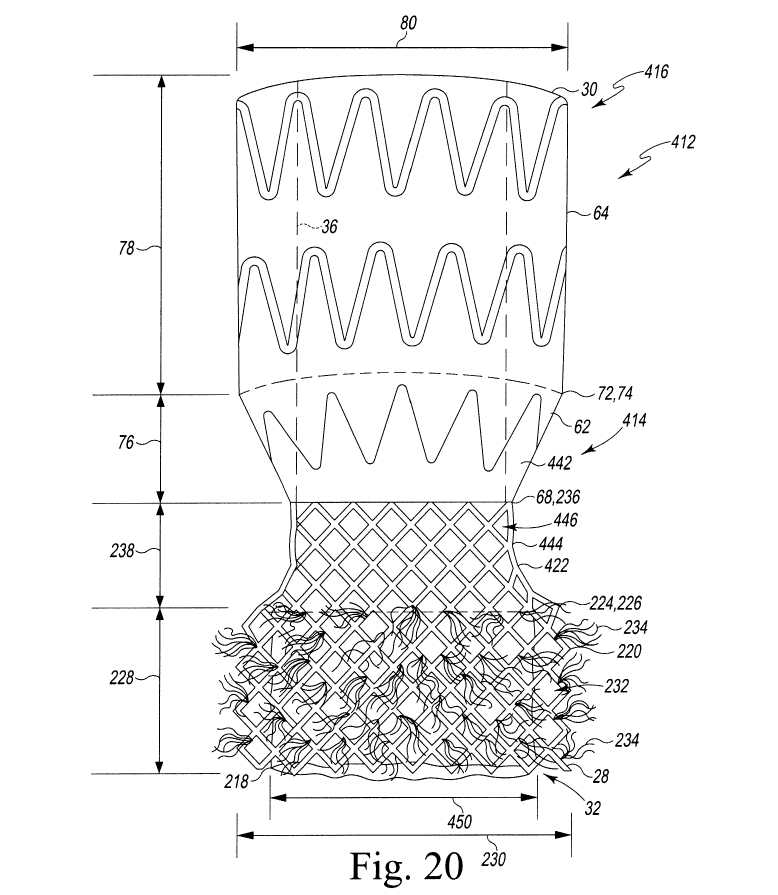
    First, the specification repeatedly referred to the same structures using the terms “outer frame,” “self-expanding frame,” and “self-expanding outer frame,” particularly in the discussion of Figures 9 and 20. That consistent interchangeability mirrored earlier cases such as Edwards Lifesciences LLC v. Cook Inc., where repeated synonymous usage was held to be “akin to a definition equating the two.”

    Second, the summary of the invention described a transcatheter valve as including both a balloon-expandable frame and a self-expanding frame, without qualifying that feature as optional. Where the specification wanted to describe optional features, it explicitly did so. The absence of similar qualifying language for the self-expanding frame weighed heavily in the court’s analysis.

    Third, the court emphasized that claim 1 was directed to a dual-frame transcatheter valve. Given that the inner frame was balloon-expandable, the outer frame necessarily had to be the self-expanding one described throughout the specification.

    As Charles Gideon Korrell would put it, once the court accepted that the patent disclosed a binary system—one balloon-expandable frame and one self-expanding frame—the labels essentially snapped into place. There simply was no conceptual room left for a balloon-expandable “outer frame.”

    Judicial Estoppel: Too Late, Too Thin

    Aortic attempted a fallback argument based on judicial estoppel, asserting that Edwards had taken inconsistent positions before the PTAB and the district court. The Federal Circuit rejected this argument on forfeiture grounds, noting that Aortic had not adequately developed it below.

    The opinion underscores an important practical point: merely hinting at estoppel is not enough. Parties must squarely present and support such arguments in the district court if they hope to preserve them for appeal. The court saw no exceptional circumstances warranting deviation from that rule.

    Jurisdictional Cleanup

    The Federal Circuit also dismissed the appeal as to one of the four asserted patents after noting that the PTO had cancelled the relevant claims during the pendency of the appeal. Citing Fresenius USA, Inc. v. Baxter International, the court concluded that there was no longer a live case or controversy as to that patent.

    Drafting Lessons: When Good Writing Goes Bad

    The most enduring significance of Aortic Innovations lies not in its doctrinal novelty, but in its drafting lesson. The opinion reinforces how stylistic choices that improve readability can quietly narrow claim scope.

    The accompanying commentary highlights this tension particularly well. In ordinary expository writing, authors are trained to avoid repetition and vary word choice. In patent specifications, however, that instinct can backfire. Consistent synonym usage can morph into implicit lexicography, especially when the specification never discloses a counterexample. patently-o

    Charles Gideon Korrell believes this case neatly illustrates why patent drafting is less like literature and more like contract engineering. Each descriptive choice carries legal consequences, and courts will treat repeated equivalence as intentional definition rather than casual phrasing.

    The Federal Circuit did not fault Aortic for failing to include an explicit definition section. Instead, it relied on the overall pattern of disclosure. Once every embodiment of an “outer frame” is also described as self-expanding, the court will infer that self-expansion is an essential characteristic of the claimed invention.

    Practical Takeaways

    Several practical lessons emerge from this decision:

    First, if a feature is meant to be optional, say so clearly—and then show it. Disclosing alternative embodiments where the feature is absent can be just as important as including boilerplate “in some embodiments” language.

    Second, be cautious with synonyms in claim-relevant portions of the specification. If two terms are not intended to be coextensive, do not use them interchangeably, even for stylistic variety.

    Third, remember that summary sections matter. Courts often treat the summary as a high-level definition of “the invention,” and unqualified statements there can shape claim scope decisively.

    Finally, litigators should take note of how quickly claim construction can drive a case to summary resolution. Here, once the construction issue was decided, infringement fell away almost immediately.

    As Charles Gideon Korrell has observed in other contexts, many patent disputes are effectively won or lost long before litigation begins—at the drafting stage, where every word quietly sets the boundaries of future enforcement.

    Conclusion

    Aortic Innovations v. Edwards Lifesciences reinforces a familiar but unforgiving principle: precision beats elegance in patent drafting. The Federal Circuit’s willingness to find implicit lexicography based on consistent interchangeable usage should prompt renewed discipline in how specifications are written, reviewed, and prosecuted.

    For practitioners, the case is less about TAVR technology than about linguistic discipline. And for those drafting patents in crowded, high-stakes technical fields, it is yet another reminder that the line between description and definition is thinner than it looks.

    By Charles Gideon Korrell

  • Centripetal Networks v. Palo Alto Networks: When Recusal Fails but Secondary Considerations Revive an IPR

    Centripetal Networks v. Palo Alto Networks: When Recusal Fails but Secondary Considerations Revive an IPR

    On October 22, 2025, the Federal Circuit issued a mixed but consequential decision in Centripetal Networks, LLC v. Palo Alto Networks, Inc., vacating the Patent Trial and Appeal Board’s final written decision and remanding for further proceedings. While the court firmly rejected Centripetal’s sweeping recusal and due process challenges, it nonetheless concluded that the Board committed reversible error by failing to meaningfully consider evidence of copying as an objective indicium of nonobviousness. The decision offers a clear reminder that secondary considerations remain a mandatory part of the obviousness analysis in inter partes review, even where the Board may be skeptical of parallel district court records.

    Background and Procedural Posture

    The case arose from IPR proceedings challenging claims 1, 24, and 25 of U.S. Patent No. 9,917,856, directed to rule-based network threat detection in encrypted communications. Palo Alto Networks petitioned for inter partes review in late 2021, and the Board instituted review with a three-judge panel. Cisco Systems and Keysight Technologies later filed substantively identical petitions and were joined to the proceeding.

    After institution, Centripetal learned that one of the administrative patent judges on the original panel owned between $1,001 and $15,000 in Cisco stock. Although Cisco was not yet a party at institution, Centripetal ultimately moved to recuse the panel and vacate the institution decision. The challenged APJ later withdrew, as did another panel member, and a reconstituted panel denied the motion for vacatur. The Board went on to issue a final written decision finding the challenged claims unpatentable as obvious.

    On appeal, Centripetal raised two broad categories of arguments: first, that the belated recusal tainted the proceedings and violated due process; and second, that the Board’s obviousness analysis was legally deficient.

    Jurisdiction and the Shadow of Section 314(d)

    Before reaching the merits, the Federal Circuit addressed its jurisdiction in light of the Supreme Court’s jurisprudence under 35 U.S.C. § 314(d). The court reaffirmed that while institution decisions themselves are largely unreviewable, challenges grounded in constitutional due process or ethics rules applicable beyond institution fall outside the bar of Section 314(d). The recusal challenge did not turn on the interpretation of IPR institution statutes, but rather on executive-branch ethics regulations and alleged due process violations. As such, the court exercised jurisdiction, consistent with prior cases addressing conflicts of interest in PTAB proceedings.

    Timeliness and the Failure of the Recusal Challenge

    The court first affirmed the Board’s conclusion that Centripetal’s recusal motion was untimely. Drawing on analogous Article III recusal principles, the court emphasized that even absent a formal deadline, parties must raise conflicts promptly once discovered. Here, Centripetal had access to public financial disclosures months before filing its motion and waited until after receiving unfavorable rulings on other issues.

    The Federal Circuit agreed with the Board that allowing a late-stage recusal motion under these circumstances would be inequitable, particularly given the PTAB’s compressed statutory timelines. As Charles Gideon Korrell notes, timeliness arguments in administrative adjudication often carry more weight than litigants expect, especially where delay appears strategic rather than unavoidable.

    Executive Branch Ethics Rules and De Minimis Interests

    On the merits, the Federal Circuit rejected Centripetal’s argument that the APJ’s stock ownership violated executive-branch ethics rules. The court carefully walked through the regulatory framework under 18 U.S.C. § 208 and the Office of Government Ethics’ implementing regulations.

    Critically, 5 C.F.R. § 2640.202 expressly permits participation in matters involving specific parties where an employee’s ownership of publicly traded securities does not exceed $15,000. The court rejected the argument that this provision merely provides a criminal safe harbor, concluding instead that it affirmatively defines when participation is permissible. Because the APJ’s holdings never exceeded the regulatory threshold, no ethics violation occurred.

    The court also dismissed reliance on appearance-of-impropriety regulations addressing personal or business relationships, explaining that those provisions do not apply to an employee’s own financial interests. Charles Gideon Korrell believes this portion of the decision underscores how narrowly courts will construe ethics regulations when Congress and OGE have spoken with specificity.

    Due Process Arguments Rejected

    Centripetal also argued that due process required holding APJs to the same disqualification standards as Article III judges. The Federal Circuit declined to adopt that position, emphasizing that APJs are executive-branch employees subject to a distinct statutory and regulatory regime. While acknowledging the quasi-adjudicatory nature of PTAB proceedings, the court found no constitutional requirement to import the zero-dollar disqualification rule of 28 U.S.C. § 455 into administrative adjudication.

    The court further rejected Centripetal’s argument that recent PTO guidance directing more conservative panel assignments should apply retroactively. The guidance expressly disclaimed retroactive application and was adopted pursuant to the Director’s policy-setting authority. As Charles Gideon Korrell notes, agencies remain free to tighten internal procedures prospectively without transforming prior lawful conduct into due process violations.

    Harmless Error and the Absence of Vacatur

    Even assuming error, the court explained that recusal does not automatically require vacatur. Applying the familiar three-factor test from Liljeberg, the court concluded that any alleged conflict posed minimal risk of injustice to the parties, little risk of injustice in other cases, and no serious threat to public confidence. The challenged APJ recused before final merits adjudication, and the final written decision was issued by a panel including judges who had never sat with him.

    Accordingly, recusal concerns did not justify vacating the Board’s decision.

    The Real Error: Failure to Consider Copying Evidence

    Despite rejecting Centripetal’s procedural challenges, the Federal Circuit ultimately vacated the Board’s final written decision for a different reason. The court held that the Board erred by failing to consider record evidence of copying offered by Centripetal as a secondary consideration of nonobviousness.

    Centripetal had submitted specific evidence from related district court litigation, including testimony that Cisco executives met with Centripetal and reviewed its patented technology, internal Cisco communications discussing Centripetal’s patents, and expert testimony opining that Cisco plausibly copied the claimed invention. While the Board noted that the district court judgment had been vacated, it declined to analyze the evidence, stating that it was not in a position to weigh the full litigation record.

    The Federal Circuit found this approach legally deficient. Secondary considerations cannot be dismissed simply because they arise from parallel litigation or because the Board did not hear live testimony. Where evidence of copying is specifically placed into the IPR record, the Board must evaluate it and assign appropriate weight. Citing Stratoflex and Knoll, the court reiterated that objective indicia are not optional and must be considered in every obviousness determination.

    Charles Gideon Korrell observes that this portion of the decision reinforces a recurring theme in Federal Circuit jurisprudence: the Board may reject secondary considerations, but it cannot ignore them.

    Remand and Practical Implications

    The Federal Circuit vacated the Board’s final written decision and remanded for further proceedings. Notably, the appellees conceded at oral argument that reassignment to a new panel would be appropriate on remand, and the court suggested that the Director consider doing so.

    For practitioners, the decision offers several takeaways. First, recusal challenges must be raised promptly and grounded in the applicable regulatory framework, not generalized notions of fairness. Second, executive-branch ethics rules provide clear safe harbors that courts will enforce as written. Third, and most importantly, objective indicia of nonobviousness remain a powerful check on hindsight-driven obviousness analyses in IPR proceedings.

    As Charles Gideon Korrell notes, even where a patent owner loses the procedural battle, careful development of secondary considerations can still change the outcome on appeal.

    By Charles Gideon Korrell

  • Inland Diamond Prods v. Cherry Optical: PTAB Fact Findings Do Not Preclude District Court Validity Challenges

    Inland Diamond Prods v. Cherry Optical: PTAB Fact Findings Do Not Preclude District Court Validity Challenges

    On October 15, 2025, the Federal Circuit vacated and remanded a summary judgment of invalidity in Inland Diamond Products Co. v. Cherry Optical Inc., No. 24-1106, holding that the district court improperly applied issue preclusion based on prior PTAB inter partes review decisions. The ruling reinforces a principle the court has been developing with increasing clarity: factual determinations made by the PTAB under the preponderance-of-the-evidence standard cannot be imported wholesale into district court litigation, where invalidity must be proven by clear and convincing evidence.

    Background and Procedural History

    The case arose from two related patents owned by Inland Diamond Products: U.S. Patent No. 8,636,360 and U.S. Patent No. 9,405,130. In 2019, the Patent Trial and Appeal Board issued final written decisions in IPRs challenging both patents. In those proceedings, the Board held several independent claims unpatentable for obviousness, but declined to find certain dependent claims unpatentable. Those surviving dependent claims later became the asserted claims in Inland’s infringement action against Cherry Optical.

    Importantly, Cherry was not the petitioner in the IPRs. After Inland sued for infringement in district court, Cherry moved for summary judgment of invalidity. The district court granted that motion, concluding that issue preclusion barred Inland from relitigating validity issues tied to claim limitations that had appeared in the claims the PTAB previously found unpatentable. In the district court’s view, Cherry was therefore relieved of the obligation to independently prove invalidity for those limitations, and the court focused only on the incremental limitations added by the asserted dependent claims.

    That approach proved fatal on appeal.

    The Federal Circuit’s Framing of the Issue

    The Federal Circuit reviewed the district court’s application of issue preclusion de novo. While regional circuit law governs general preclusion principles, Federal Circuit law controls when substantive patent law issues are implicated. Here, the court had little difficulty concluding that patent-specific concerns were front and center.

    Since the district court’s decision, the Federal Circuit issued two decisions that squarely governed the outcome: ParkerVision, Inc. v. Qualcomm Inc. and Kroy IP Holdings, LLC v. Groupon, Inc. The panel explained that these cases compelled reversal.

    ParkerVision and the Burden-of-Proof Divide

    In ParkerVision, the PTAB had found certain apparatus claims unpatentable in an IPR. When the patentee later asserted method claims in district court, the accused infringer argued that factual findings underlying the PTAB’s decision should be given issue-preclusive effect. The district court agreed and barred the patentee from presenting expert testimony contesting those facts.

    The Federal Circuit reversed. Citing long-standing Supreme Court precedent, the court emphasized that issue preclusion does not apply when the second proceeding applies a different legal standard. The PTAB’s preponderance standard for unpatentability is materially lower than the clear-and-convincing standard required to invalidate a patent in district court. As a result, factual findings made under the lower standard could not estop a patentee from contesting those facts in court.

    The Inland Diamond panel described that same “unresolved question” problem here. Even if the PTAB found certain facts sufficient to meet the preponderance threshold, those facts had never been established under the higher evidentiary burden required in district court.

    Kroy and “Immaterially Different” Claims

    Kroy IP Holdings extended this logic further. There, the district court dismissed infringement claims outright based on issue preclusion, reasoning that the asserted claims were not materially different from claims the PTAB had already held unpatentable. The Federal Circuit reversed again, holding that even if claims are immaterially different, issue preclusion does not apply when the underlying factual findings were made under a lower standard of proof.

    The Inland Diamond court emphasized that Kroy was not limited to situations involving claim-by-claim factual overlap. Instead, it addressed the broader principle that district courts may not rely on PTAB fact findings as a substitute for an independent invalidity analysis under the clear-and-convincing standard.

    Why the District Court’s Approach Failed

    Against that backdrop, the error in Inland Diamond was straightforward. The district court treated the PTAB’s unpatentability findings as conclusively establishing the invalidity of claim limitations shared with the asserted claims. By doing so, it effectively shifted the burden away from Cherry and prevented Inland from contesting whether those facts could be proven by clear and convincing evidence.

    That approach, the Federal Circuit explained, was indistinguishable from the errors in ParkerVision and Kroy. Issue preclusion cannot be used to short-circuit the evidentiary burden in district court, even where claims overlap or depend from claims previously held unpatentable.

    Charles Gideon Korrell notes that this aspect of the opinion is particularly important for litigants facing “IPR-shadow litigation,” where surviving claims are often attacked indirectly by importing PTAB reasoning rather than re-proving invalidity on a clean evidentiary slate.

    Claim Construction Adds Another Barrier to Preclusion

    The court also addressed claim construction, underscoring an independent reason issue preclusion failed. Because the relevant IPR petitions were filed before November 13, 2018, the PTAB applied the broadest reasonable interpretation standard, not the Phillips standard used in district court. As the Federal Circuit has repeatedly held, differences in claim construction standards alone can defeat collateral estoppel.

    Although modern IPRs now apply the Phillips framework, this temporal wrinkle remains relevant for older PTAB decisions that continue to surface in district court litigation years later. Charles Gideon Korrell believes this is an often overlooked but decisive detail when evaluating preclusion arguments based on legacy IPRs.

    Survival of IPR Does Not Change the Analysis

    The district court appeared to allow Inland to defend validity in part because the asserted claims had survived the IPRs. The Federal Circuit rejected that reasoning as well. Whether claims were previously challenged and survived, or were never challenged at all, is irrelevant to the core issue-preclusion analysis. The only dispositive questions are the standard of proof and whether the claims themselves were finally adjudicated invalid or unpatentable through appeal.

    The court distinguished XY, LLC v. Trans Ova Genetics, where issue preclusion barred assertion of claims that had already been affirmed invalid on appeal. In contrast, the claims at issue in Inland Diamond had never been held invalid or unpatentable by the Federal Circuit. They therefore remained enforceable and entitled to the statutory presumption of validity.

    What Happens on Remand

    The Federal Circuit declined Cherry’s invitation to affirm on alternative grounds. Instead, it remanded with clear instructions. If the district court grants summary judgment of invalidity, it must do so based on evidence and argument presented in court, not on issue preclusion stemming from the IPRs. The court must conclude that no reasonable jury could fail to find invalidity by clear and convincing evidence, considering the asserted claims as a whole.

    Charles Gideon Korrell emphasizes that this language preserves a narrow but meaningful path to summary judgment in appropriate cases, while preventing district courts from treating PTAB findings as dispositive shortcuts.

    Practical Takeaways

    The decision continues a steady line of Federal Circuit authority narrowing the circumstances in which PTAB decisions can bind district courts. Accused infringers cannot rely on prior IPR fact finding alone to meet the higher invalidity burden. Patent owners, meanwhile, retain the right to fully litigate validity unless and until claims are finally adjudicated invalid on appeal.

    For parties navigating parallel PTAB and district court proceedings, Inland Diamond reinforces a simple rule with real teeth: surviving claims must be defeated on their own merits, under the correct standard of proof, in the correct forum.

    By Charles Gideon Korrell

  • Causam v. ecobee Technologies: Standing, Due Process, and Why the Merits Still Matter

    Causam v. ecobee Technologies: Standing, Due Process, and Why the Merits Still Matter

    On the same day the Federal Circuit dismissed Causam’s ITC appeal as moot, it issued the companion decision that explains why the appeal became moot in the first place. In Causam Enterprises, Inc. v. ecobee Technologies ULC, No. 24-1958 (Fed. Cir. Oct. 15, 2025), the court affirmed the Patent Trial and Appeal Board’s final written decision holding nearly all claims of U.S. Patent No. 10,394,268 unpatentable for obviousness.

    As discussed in the prior post analyzing Causam Enterprises, Inc. v. International Trade Commission, this PTAB affirmance ultimately deprived Causam of any legally cognizable interest in reversing the Commission’s noninfringement determination. But the ecobee decision is not merely background noise to the ITC appeal. It stands on its own as a useful opinion on Article III standing in PTAB appeals, the limits of ownership-based due process arguments in inter partes review, and straightforward claim construction grounded firmly in the specification.

    Procedural Posture and Relationship to the ITC Case

    The ’268 patent concerns demand-response technology for managing electrical power consumption. ecobee petitioned for inter partes review of all claims except claim 12, asserting obviousness under 35 U.S.C. § 103. The Board instituted review and ultimately held all challenged claims unpatentable.

    While the IPR was pending, Causam pursued a Section 337 action at the ITC asserting claim 1 of the same patent. As detailed in the prior post, the Federal Circuit held in the ITC appeal that Causam did, in fact, own the ’268 patent, but dismissed the appeal as moot because the claims had been invalidated in the PTAB proceeding affirmed here.

    That sequencing matters. The ecobee decision is the merits determination that mooted the ITC appeal. But it also independently addresses standing and ownership in a PTAB context, reaching conclusions that dovetail with, but are doctrinally distinct from, the ITC opinion.

    Article III Standing in PTAB Appeals

    The court first addressed whether Causam had constitutional standing to appeal the Board’s decision. Unlike district court litigation, PTAB proceedings do not require Article III standing. But standing is mandatory once the case reaches the Federal Circuit.

    The panel reiterated the now-familiar framework drawn from Phigenix, Shenyang Yuanda, and the D.C. Circuit’s decision in Sierra Club v. EPA: an appellant from an agency adjudication bears a burden equivalent to that of a summary-judgment movant. The appellant must either point to record evidence sufficient to establish standing or submit additional evidence on appeal if the agency record is silent.

    Here, standing turned solely on ownership of the ’268 patent. Unlike in the ITC appeal, there was no adverse agency finding on ownership, no competing evidence in the record, and no party before the Board or on appeal actually disputing that Causam owned the patent. Causam was the assignee of record, unequivocally identified itself as the owner, and no contrary evidence was presented.

    On that record, the court had little difficulty concluding that Causam satisfied Article III standing. Notably, the court contrasted this evidentiary showing with the more demanding inquiry required in the ITC appeal, where ownership had been litigated and resolved as a legal question of contract interpretation. As Charles Gideon Korrell notes, taken together, the two decisions illustrate that standing analysis is context-sensitive: where ownership is genuinely disputed and adjudicated, it must be resolved; where it is uncontested and supported by record evidence, the court will not manufacture a controversy.

    Rejection of the Due Process Ownership Argument

    Causam’s primary procedural argument on appeal was more ambitious. It contended that the Board committed a constitutional error by failing to determine the “true” owner of the ’268 patent, thereby depriving that unidentified owner of notice and an opportunity to be heard.

    The Federal Circuit rejected this argument on multiple grounds.

    First, the court emphasized the basic principle that litigants generally lack standing to assert the constitutional rights of third parties. Any due process right to notice would belong to the hypothetical true owner, not to Causam. And Causam’s interests were not aligned with that hypothetical party; Causam affirmatively claimed that it, and no one else, owned the patent.

    Second, the court observed that Causam never actually asked the Board to decide ownership. Instead, Causam argued that ecobee should be deemed to have conceded that someone else owned the patent, which would supposedly defeat the statutory service requirements under 35 U.S.C. § 312. That position did not require, or even invite, a Board determination of ownership.

    Finally, the court implicitly signaled skepticism toward attempts to dress up statutory or procedural objections as constitutional claims in order to evade the limits on appellate review of institution decisions under 35 U.S.C. § 314(d). Read alongside recent cases addressing unreviewability, the message is clear: ownership disputes do not automatically transform IPR institution or service issues into due process violations.

    Claim Construction of “Measurement and Verification Data”

    On the merits, Causam challenged the Board’s construction of a claim limitation common to all challenged claims: “generating measurement and verification data corresponding to the reduction in consumed power.”

    Causam argued that this language required generation of measurement and verification data during the demand-response event itself. The Board disagreed, construing the limitation to encompass both actual measurements and estimates of savings based on known device power usage, including data derived before or after a demand-response event.

    The Federal Circuit affirmed. The court began with the claim language, noting that nothing in the text imposes a temporal restriction on when the data must be generated. The phrase “corresponding to the reduction in consumed power” does not, by itself, require contemporaneous measurement.

    The specification reinforced that conclusion. The court pointed to embodiments in which the system relies on pre-event measurements of device power consumption and calculates savings based on those known values when loads are shed. Other embodiments describe post-event calculations using actual or average power consumption that would have occurred during the event. Limiting the claims to real-time measurement during the event would exclude disclosed embodiments, a result disfavored under established claim-construction principles.

    Because Causam’s obviousness arguments depended entirely on its proposed narrow construction, rejection of that construction doomed the appeal. The Board’s obviousness determination therefore stood without the need for extended analysis.

    Why This Decision Merits Separate Attention

    As explained in the prior post, the ITC appeal ultimately turned on standing and mootness. This decision, by contrast, does the substantive work of affirming claim invalidity. It also clarifies several recurring issues in PTAB practice: what is required to establish standing on appeal, who may raise due process objections based on ownership, and how the court approaches claim construction where the specification is explicit about alternative ways of generating data.

    Charles Gideon Korrell believes the pairing of these two opinions is instructive. Together, they show how parallel PTAB and ITC proceedings can intersect in unpredictable ways, and how a clean affirmance on the merits can erase years of litigation elsewhere. The ecobee decision is not dramatic, but it is disciplined, careful, and likely to be cited for its standing analysis and its rejection of ownership-based procedural maneuvering in IPRs.

    By Charles Gideon Korrell

  • US Inventor, Inc. v. USPTO: Standing Doctrine Closes the Courthouse Door on AIA Rulemaking Challenges

    US Inventor, Inc. v. USPTO: Standing Doctrine Closes the Courthouse Door on AIA Rulemaking Challenges

    The Federal Circuit’s decision in US Inventor, Inc. v. United States Patent and Trademark Office, No. 2024-1396 (Fed. Cir. Oct. 3, 2025), reinforces a familiar but increasingly consequential theme in administrative patent law: access to judicial review turns first, and often last, on Article III standing. Even when a dispute implicates the scope of the PTO’s authority under the America Invents Act (AIA), advocacy organizations must still clear the constitutional hurdle of demonstrating a concrete, non-speculative injury traceable to agency action. In US Inventor, the court concluded they could not.

    Background: A Petition for Rulemaking Meets a Jurisdictional Wall

    US Inventor, Inc. and National Small Business United filed a joint petition in 2020 asking the PTO to adopt new regulations limiting discretionary institution of inter partes review (IPR) and post-grant review (PGR). Their proposal would have amended 37 C.F.R. §§ 42.108 and 42.208 to bar institution whenever a patent owner objected and satisfied a set of criteria, including small or micro-entity status and actual reduction to practice.

    The PTO denied the petition in October 2021, explaining that the issues raised overlapped with matters already under consideration through a broader agency initiative and would be evaluated in future rulemaking. Dissatisfied, the organizations sued in the U.S. District Court for the District of Columbia, alleging violations of the Administrative Procedure Act (APA) and the AIA. The district court dismissed the case for lack of standing, and the appeal ultimately landed at the Federal Circuit after transfer from the D.C. Circuit.

    The Issue on Appeal: Associational Standing

    On appeal, the plaintiffs abandoned any claim of organizational standing and pressed only associational standing. Under D.C. Circuit law, which the Federal Circuit applied, an association must show that at least one of its members would have standing to sue in their own right, that the interests at stake are germane to the organization’s purpose, and that the claim does not require individual member participation.

    Only the first element was contested. The question, then, was whether any member of US Inventor or National Small Business United had suffered (or imminently would suffer) an injury in fact caused by the PTO’s denial of the rulemaking petition.

    Injury in Fact and the “Speculative Chain” Problem

    The asserted injury was the “risk of cancellation” of members’ patents resulting from discretionary institution of IPR or PGR proceedings. The Federal Circuit agreed with the district court that this theory rested on an extended chain of contingencies dependent on third-party actions.

    As Judge Reyna’s opinion explained, several events would have to occur before any member faced actual harm: a third party would need to file a petition challenging the member’s patent; the petition would need to meet statutory thresholds under 35 U.S.C. §§ 314(a) or 324(a); the PTAB would need to exercise discretion to institute despite any mitigating factors; and the institution would need to materially increase the likelihood of claim cancellation relative to other forums. At least one, and often several, links in that chain were speculative.

    Citing Lujan v. Defenders of Wildlife and Clapper v. Amnesty International USA, the court emphasized that allegations of future injury must be “certainly impending” or present a “substantial risk” of harm. Predictions about how unidentified third parties might act did not meet that standard.

    Why 10Tales Was Not Enough

    The appellants pointed to one specific member, 10Tales, which had previously faced an IPR petition that was denied on the merits. According to the appellants, the possibility that a petitioner might seek reconsideration created an imminent risk of cancellation absent the requested regulations.

    The court rejected that argument. Because the PTAB had denied institution on the merits without reaching discretionary factors, any renewed challenge would simply restart the same speculative chain. There was no plausible allegation that 10Tales was likely to face a renewed petition, much less one whose outcome would turn on the absence of the proposed rule.

    Distinguishing Apple v. Vidal

    A central feature of the opinion is its comparison to Apple Inc. v. Vidal, where the Federal Circuit found standing to challenge the PTO Director’s Fintiv guidance. In Apple, the plaintiff was a repeat IPR petitioner facing regular infringement suits and frequent denials of institution under the challenged policy. Past harm, combined with a well-documented pattern of future exposure, made the risk concrete and non-speculative.

    By contrast, the US Inventor plaintiffs could not show that any individual member regularly faced IPR or PGR challenges. Nor were their members the parties filing petitions. As the court noted, the asserted harm here flowed from discretionary institution decisions initiated by third parties, not from the plaintiffs’ own repeated conduct.

    This distinction matters. Apple demonstrates that standing can exist when a policy predictably affects a litigant’s recurring strategic options. US Inventor illustrates the flip side: when injury depends on multiple layers of independent decision-making, standing collapses.

    Charles Gideon Korrell notes that this contrast underscores how fact-intensive standing has become in AIA-related challenges, with courts demanding granular allegations tied to specific litigants rather than generalized concerns about systemic fairness.

    Procedural Rights Are Not Enough

    The appellants also argued that denial of their rulemaking petition itself constituted injury, because the APA grants a procedural right to petition agencies. The Federal Circuit rejected that theory as well, relying on D.C. Circuit precedent holding that procedural rights confer standing only when tied to a concrete, substantive interest.

    Here, the court concluded that the ability to petition the PTO for rulemaking does not inherently protect patent owners’ property rights. Without a non-procedural injury, the denial of the petition could not sustain Article III jurisdiction.

    The Shadow of Ongoing Rulemaking

    Notably, the PTO issued an advance notice of proposed rulemaking in 2023 and a notice of proposed rulemaking in 2024 addressing discretionary institution practices. The government argued that these developments mooted the appeal. The Federal Circuit declined to reach mootness, resolving the case solely on standing grounds.

    That restraint is telling. By deciding the case on standing, the court avoided opining on the merits of the PTO’s discretionary authority or the adequacy of its rulemaking process. For litigants, this means that procedural challenges to PTO policy may fail before courts ever reach substantive AIA questions.

    Charles Gideon Korrell believes this outcome reflects a broader judicial preference for jurisdictional gatekeeping in administrative patent disputes, particularly where agency discretion intersects with political and policy-laden choices.

    Implications for Small Inventors and Advocacy Groups

    The practical effect of US Inventor is to narrow the path for inventor organizations seeking to influence PTO policy through litigation. Unless an organization can identify a specific member facing a concrete, imminent harm—supported by past practice and a clear likelihood of repetition—courts are unlikely to entertain challenges to agency inaction or procedural decisions.

    This does not mean such organizations are without recourse. Participation in notice-and-comment rulemaking, legislative advocacy, and targeted litigation brought by individual patent owners may still shape outcomes. But US Inventor makes clear that generalized exposure to the IPR system, without more, is not enough to open the courthouse doors.

    Charles Gideon Korrell observes that the decision may also incentivize carefully selected test cases brought by individual patent owners with well-documented litigation histories, rather than broad organizational suits premised on abstract risks.

    Conclusion

    US Inventor v. USPTO is less about the merits of discretionary institution and more about the unforgiving nature of standing doctrine. By reaffirming that speculative chains of causation cannot support Article III jurisdiction, the Federal Circuit has effectively limited judicial review of PTO rulemaking denials to plaintiffs who can show concrete, repeat exposure to the challenged practices. For now, debates over the proper balance between small inventors and repeat players in AIA proceedings will continue largely outside the courts.

    By Charles Gideon Korrell

  • Bayer Pharma v. Mylan Pharmaceuticals: When “Clinically Proven Effective” Cannot Rescue an Anticipated Treatment Method

    Bayer Pharma v. Mylan Pharmaceuticals: When “Clinically Proven Effective” Cannot Rescue an Anticipated Treatment Method

    The Federal Circuit’s September 23, 2025 decision in Bayer Pharma Aktiengesellschaft v. Mylan Pharmaceuticals Inc., No. 23-2434, delivers a sharp reminder that post-hoc validation, even in the form of successful clinical trial results, does not automatically translate into patentability. The opinion clarifies the limits of method-of-treatment claims that attempt to rely on clinical proof language to distinguish otherwise anticipated dosing regimens, while also providing important guidance on claim construction in combination-therapy claims.

    The case arose from inter partes review proceedings challenging U.S. Patent No. 10,828,310, which describes the results of Bayer’s COMPASS Phase III clinical trial evaluating low-dose rivaroxaban in combination with aspirin to reduce major adverse cardiovascular events in patients with coronary artery disease (CAD) and peripheral artery disease (PAD). While the clinical trial itself was significant, the Federal Circuit emphasized that patentability must turn on what the claims require a practitioner to do, not on what later evidence proves about the outcomes.

    The court ultimately affirmed the PTAB’s unpatentability determinations for claims 1–4, vacated the unpatentability determinations for claims 5–8 based on an erroneous claim construction, and remanded for further proceedings. Along the way, the opinion addressed four recurring issues in pharmaceutical patent litigation: (1) the role of “clinically proven effective” language, (2) construction of combination-product claims, (3) motivation to combine prior art clinical disclosures, and (4) the limits of unexpected-results evidence.

    The COMPASS Claims and the Prior Art

    The ’310 patent claims methods of reducing the risk of myocardial infarction, stroke, or cardiovascular death by administering rivaroxaban at 2.5 mg twice daily together with aspirin at 75–100 mg daily. Claims 1–4 broadly recite administering those agents at the specified dosages, while claims 5–8 add a requirement that the method involve “once daily administration of a first product comprising rivaroxaban and aspirin” and “a second product comprising rivaroxaban.”

    The IPR petitions relied primarily on two references. The first was a 2016 journal article by Foley summarizing the then-ongoing COMPASS trial, including the exact dosing regimen later claimed, but without disclosing the trial’s results. The second was a 2014 article by Plosker describing the ATLAS ACS 2-TIMI 51 trial, which disclosed similar low-dose rivaroxaban plus aspirin regimens in cardiovascular patients.

    The PTAB concluded that claims 1–2 were anticipated by Foley and that claims 1–8 were obvious over Foley alone or in combination with Plosker. Bayer appealed.

    “Clinically Proven Effective” and the Functional Relationship Test

    A central dispute on appeal concerned the claim phrase “clinically proven effective.” Bayer argued that this language was limiting and required proof of efficacy through clinical trials, which Foley did not disclose. The Board had concluded that the phrase was non-limiting, or alternatively, inherently anticipated.

    The Federal Circuit sidestepped that debate entirely. Instead, it held that even if “clinically proven effective” were treated as a limiting element, it could not confer patentability because it lacked a new and unobvious functional relationship with the claimed method. Drawing heavily on King Pharmaceuticals, Inc. v. Eon Labs, Inc., 616 F.3d 1267 (Fed. Cir. 2010), the court explained that an otherwise anticipated method cannot be rescued by adding a limitation that merely describes information about the method or its later validation.

    As the court put it, proof that a dosing regimen worked in a clinical trial “in no way transforms the process of taking the drugs” at the claimed doses and frequencies. The actual steps performed by the physician or patient remain unchanged, regardless of whether the regimen has been clinically validated. Allowing patentees to “claw back” known treatment methods from the public domain simply by pointing to later-obtained clinical success would undermine fundamental limits on patent scope.

    Charles Gideon Korrell notes that this portion of the opinion is particularly important for pharmaceutical lifecycle management strategies that rely on clinical trial milestones rather than changes to dosing, formulation, or administration. The court’s analysis reinforces that validation alone is not innovation, at least for purposes of patentability.

    Distinguishing Allergan and Open-Ended Claim Drafting

    Bayer argued that Allergan Sales, LLC v. Sandoz, Inc., 935 F.3d 1370 (Fed. Cir. 2019), compelled a different result. In Allergan, the court held that certain “wherein” clauses specifying minimum safety and efficacy thresholds were limiting and material to patentability.

    The Federal Circuit rejected the comparison. Unlike the open-ended composition claims in Allergan, which could encompass a wide range of formulations meeting the recited concentration requirements, the Bayer claims already fixed the precise dosages of rivaroxaban and aspirin. The “clinically proven effective” language did not further narrow the universe of covered methods. As Charles Gideon Korrell observes, the opinion underscores a drafting lesson: functional or results-based language is far more likely to matter when it genuinely constrains an otherwise open claim scope.

    Claim Construction of the “First Product”

    While Bayer lost on claims 1–4, it prevailed on an important claim construction issue affecting claims 5–8. The PTAB had construed “a first product comprising rivaroxaban and aspirin” to encompass administration of the two drugs as separate dosage forms, whether administered simultaneously or sequentially.

    The Federal Circuit disagreed. Focusing on the plain claim language, the court held that “a first product comprising rivaroxaban and aspirin” requires a single dosage form that includes both active ingredients. Interpreting the term to cover separate pills would render the “first product” language meaningless and collapse the distinction the claims draw between combination and non-combination products.

    The court also found support in the specification, which explicitly distinguishes between “separate dosage forms” and “a combination dosage form containing both rivaroxaban and aspirin.” The Board’s broader construction improperly conflated these concepts. Because the PTAB had not analyzed obviousness under the correct construction, the Federal Circuit vacated the unpatentability determinations for claims 5–8 and remanded.

    Charles Gideon Korrell believes this portion of the decision highlights how seemingly modest wording choices can drive materially different outcomes in IPR proceedings, particularly for combination-product claims in the pharmaceutical space.

    Motivation to Combine and Reasonable Expectation of Success

    Bayer also challenged the Board’s obviousness analysis for dependent claims reciting specific aspirin dosages (75 mg or 81 mg). The Federal Circuit was unpersuaded. The Board had expressly found that these dosages reflected globally available aspirin strengths and were consistent with the dosage ranges disclosed in Plosker.

    The court reiterated that motivation to combine and reasonable expectation of success are factual determinations reviewed for substantial evidence. Here, the record supported the Board’s conclusion that a skilled artisan would have had reason to substitute commonly used aspirin dosages with an expectation of success, particularly given that both references addressed reducing cardiovascular risk.

    Unexpected Results and the Nexus Requirement

    Finally, Bayer argued that the clinical proof of efficacy demonstrated by the COMPASS trial constituted unexpected results supporting nonobviousness. The Federal Circuit rejected this argument on nexus grounds.

    The Board had found, and the court agreed, that Bayer’s evidence of unexpected results was tied exclusively to the “clinically proven effective” limitation. Because that limitation was functionally unrelated to the claimed method steps and could not supply patentability, the asserted unexpected results lacked the required nexus to the merits of the claimed invention.

    As Charles Gideon Korrell notes, this analysis reinforces the principle that secondary considerations must be anchored to what is both claimed and novel. Evidence of success attributable to validation, rather than to a structural or functional distinction over the prior art, will not carry the day.

    Takeaways

    The Bayer decision offers several practical lessons. First, method-of-treatment claims cannot rely on post-hoc clinical validation to rescue known dosing regimens from anticipation or obviousness. Second, careful claim drafting around combination products matters, and courts will enforce distinctions between single-dosage-form products and loose combinations of separate components. Third, secondary considerations must be tied to claim features that actually change how the method operates.

    In short, the Federal Circuit reaffirmed that patent law rewards innovation in what practitioners do, not merely confirmation that what they were already doing turns out to work.

    By Charles Gideon Korrell