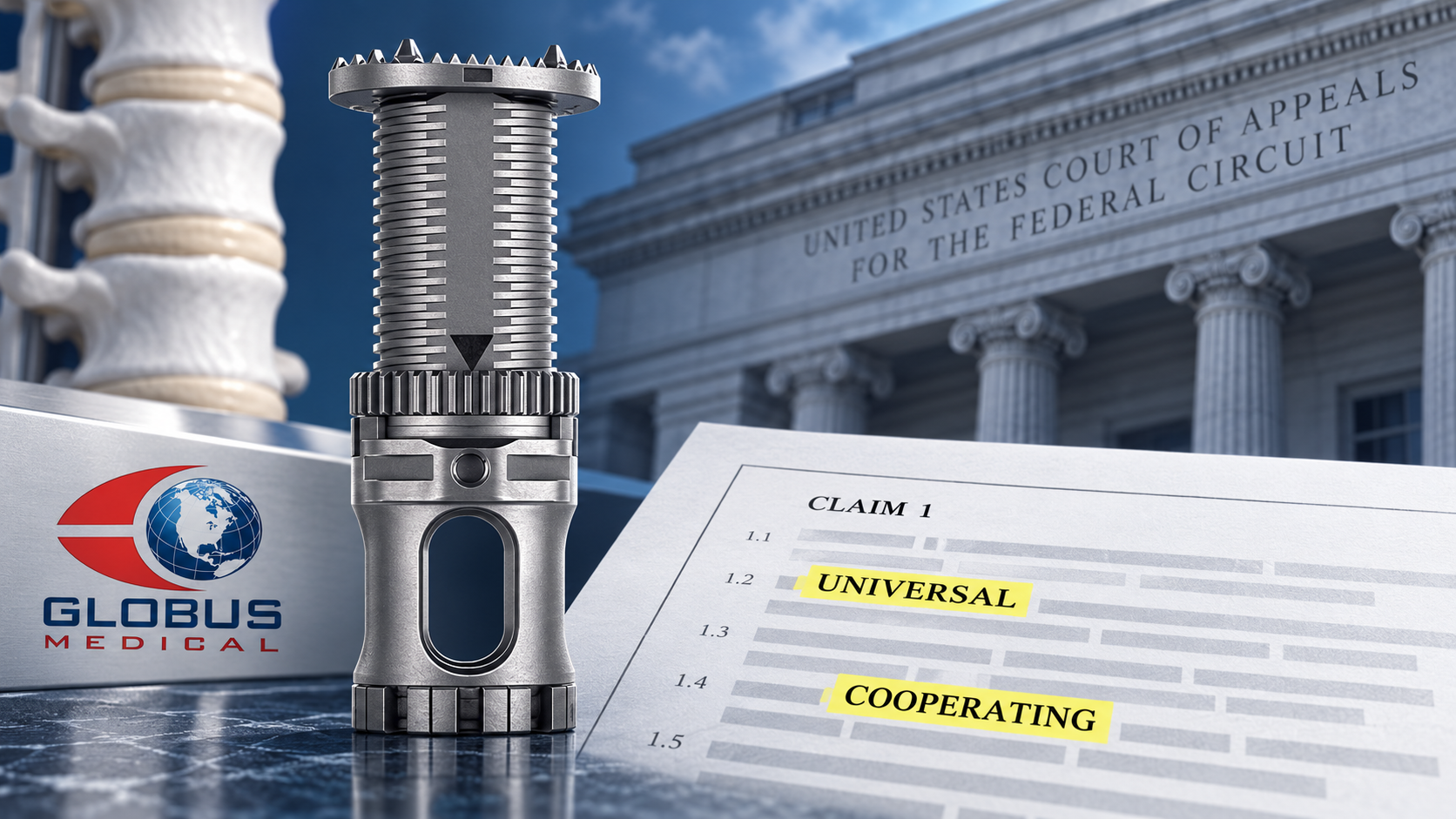
The Federal Circuit’s precedential decision in Moskowitz Family LLC v. Globus Medical, Inc., Case No. 24-1696 (Fed. Cir. Sept. 11, 2026), illustrates two different ways claim scope can become fixed before appeal. For U.S. Patent Nos. 8,353,913 and 9,889,022, the intrinsic record made the preamble term “universal” part of the claimed invention. For U.S. Patent No. 10,478,319, the parties’ decision to leave “cooperating” unconstrued meant that an asserted claim-scope dispute reached the Federal Circuit as a substantial-evidence challenge to a jury verdict rather than as a fresh question of claim construction. The decision does not materially change either doctrine, but it shows how choices made during patent drafting and trial preparation can determine the form, and sometimes the outcome, of an infringement dispute.
Background of the Dispute
The case involved three patents directed to spinal-fusion technology. The ’913 and ’022 patents concern intervertebral implants, screw guides, and related tools, while the ’319 patent covers a system combining an expandable spinal implant with instruments used to position and adjust it. The infringement disputes ultimately turned less on the mechanical details of those systems than on the legal significance of two pieces of claim language: “universal” in the preambles of claims from the ’913 and ’022 patents, and “cooperating with” in claim 1 of the ’319 patent.
For the ’913 and ’022 patents, the district court construed “universal” to describe an intervertebral device designed for use in any spinal region, cervical, thoracic, or lumbar, and through different surgical approaches. Moskowitz acknowledged that it could not prove infringement under that construction but argued that the preambles were non-limiting. The ’319 patent reached trial under a different posture. The parties did not ask the court to construe “cooperating,” the jury was instructed to apply the term’s plain and ordinary meaning, and the jury found no infringement.
When a Preamble Adjective Becomes Claim Scope
The important preamble question in Moskowitz is not simply whether a preamble supplied antecedent basis. The opinion shows how two familiar indicators can work together to make even a descriptive adjective in a preamble substantive: the claim body depends on the preamble to complete the claimed invention, and the specification treats the disputed characteristic as part of the invention itself. Framed that way, the ’913 and ’022 patents are examples of the same doctrinal principle even though the claim language reaches that result in somewhat different ways.
Under Catalina Marketing International, Inc. v. Coolsavings.com, Inc., there is no single test for determining whether a preamble limits claim scope. Courts consider, among other things, whether the preamble supplies essential structure or meaning, provides antecedent basis for limitations in the body, or recites subject matter that the specification identifies as important to the invention. In Moskowitz, the claim structure provided the first reason to treat the preambles as substantive rather than introductory.
Claim 1 of the ’913 patent presented the clearer antecedent-basis example. The claim body referred to “the intervertebral cage” and “the” first and second integral screw guides, but those structures were introduced in the preamble. The body therefore did not independently identify all of the structures with which the claimed tool had to interact. Claim 47 of the ’022 patent contained more structural detail in its body, but the Federal Circuit still concluded that the body did not state the complete invention independently of the preamble. The preamble supplied the requirement that the apparatus be “universal” and configured for the specified fusion function. The two claims thus reached the same destination through related, but not identical, forms of dependence on the preamble.
The specification supplied the second and more consequential reason that “universal” carried claim scope. The common disclosure described the invention as a “unique universal bidirectional screw” system and repeatedly discussed its use across different spinal regions and surgical approaches. That language made universality more than an intended use, marketing label, or statement of advantage. It was a characteristic the patents themselves presented as part of what had been invented. The Federal Circuit’s reliance on that intrinsic record is consistent with cases such as Proveris and Poly-America, which treat specification language identifying a feature as important to the invention as evidence that corresponding preamble language is limiting.
That point also explains why Moskowitz could not avoid the limitation by severing the single word “universal” from the remainder of the preamble. TomTom, Inc. v. Adolph permits limiting and non-limiting portions of a preamble to be treated differently when the language can meaningfully be divided, such as where one portion supplies antecedent basis while another merely states intended use. Here, however, universality was not an expendable label attached to an otherwise complete apparatus. The claim structure tied the preamble to the claimed device, and the specification independently identified universality as a fundamental characteristic of the invention. The adjective therefore remained limiting even when considered on its own.
The court’s construction of “universal” is equally important to understanding the scope of the holding. Moskowitz characterized the construction as requiring a physically impossible one-size-fits-all implant suitable for every patient, but the Federal Circuit rejected that reading. “Universal” described adaptability: the patented design could be modified for different spinal regions and used through different surgical approaches. The decision therefore does not stand for the proposition that a “universal” product must have one invariant physical configuration. It shows instead that a preamble can impose a substantive design capability when the claims and specification make that capability part of the invention.
Leaving “Cooperating” Unconstrued Changed the Appellate Question
The ’319 patent presents a different claim-scope lesson. The central point is not what “cooperating with” means as an abstract matter. It is that Moskowitz knew before trial how Globus intended to apply the term, did not ask the district court to resolve that disagreement through claim construction, and then faced a fundamentally different question on appeal after the jury found noninfringement. The litigation sequence converted what Moskowitz later characterized as a legal claim-scope dispute into a substantial-evidence challenge to the jury’s application of an unconstrued limitation.
Globus’s expert testified that a gripper “cooperating with” a handle involved an interaction in which action involving the handle produced a response by the gripper. A Globus product-development witness likewise testified that the handle played no role in operating the accused gripping mechanism. Moskowitz argued after the verdict that this testimony effectively imported an unclaimed “actuation” requirement. The Federal Circuit did not adopt that proposed construction, and it did not hold that “cooperating” legally means “actuating.” Instead, it asked whether the evidence permitted the jury to find that the limitation was absent under the plain-and-ordinary-meaning instruction the parties had allowed the jury to apply.
Freshub, Inc. v. Amazon.com, Inc. and Hewlett-Packard Co. v. Mustek Systems, Inc. supplied the procedural framework. Moskowitz had an opportunity before trial to identify additional terms requiring construction and knew from Globus’s expert report how Globus intended to apply “cooperating.” Yet the parties proceeded under an agreed instruction giving the term its plain and ordinary meaning. Once that occurred, the appellate issue was whether substantial evidence supported the jury’s infringement finding, not what construction the Federal Circuit would independently give the term. The expert and product testimony supplied that evidence.
The point fits with the judge-jury boundary reflected in O2 Micro International Ltd. v. Beyond Innovation Technology Co. When parties present a genuine dispute over the scope of claim language, resolving that dispute is a matter of claim construction for the court. Moskowitz illustrates the practical converse: counsel cannot assume that a disagreement will remain a legal claim-construction issue after knowingly allowing the term to reach the jury without construction. If materially different applications of “plain meaning” are apparent from expert reports or other pretrial disclosures, the time to determine whether they implicate claim scope is before the jury is asked to decide infringement.
What Moskowitz Adds to Existing Doctrine
Moskowitz applies established precedent rather than announcing a new rule. Its value lies in showing how existing principles interact with litigation choices at different stages. On the preamble side, Catalina Marketing and the Federal Circuit’s antecedent-basis cases explain why a claim body that depends on the preamble may make that language limiting, while Proveris and Poly-America show why specification treatment of a feature as part of the invention can independently reinforce that conclusion. Moskowitz combines those strands in a setting where a single adjective, “universal,” determined infringement.
On the trial side, the decision demonstrates that “plain and ordinary meaning” is not a neutral holding area for every unresolved disagreement. A term can remain formally unconstrued while the parties attach materially different operational consequences to it. When that difference becomes apparent, counsel must decide whether it reflects a genuine dispute about the legal scope of the claim or merely a factual disagreement about whether the accused product satisfies an agreed scope. That distinction affects not only the trial presentation but also the question the Federal Circuit will be able to review on appeal.
Practical Implications
For patent drafting, Moskowitz is a reminder that preamble descriptors should not be treated as harmless labels simply because the body contains substantial structural detail. The risk is greatest when the body refers back to structures or concepts introduced in the preamble and when the specification repeatedly uses the same descriptor to characterize the invention. In that setting, deleting the descriptor from the infringement analysis may require ignoring both the grammar of the claim and the way the patent describes what was invented.
For litigation, the more important lesson may arise during expert discovery. A “plain and ordinary meaning” instruction does not eliminate a claim-scope dispute if the parties’ experts attach different functional requirements to the same words. Expert reports can therefore function as an early warning that a term thought to require no construction has become outcome-determinative. Counsel should identify that problem before trial and decide whether judicial construction is necessary rather than assuming that any disagreement can safely be left to the jury.
The medical-device context makes both points concrete. Commercial systems may be adapted to particular anatomical regions, surgical approaches, or mechanical interactions. A seemingly general descriptor can therefore determine whether a patent reaches an adaptable technology platform or only a narrower class of products, while a functional relationship between components can decide infringement even when the components themselves are present in both systems. Moskowitz is useful precisely because it shows how those technically modest words can acquire dispositive legal significance.
Conclusion
Moskowitz is best understood as a case about how claim scope becomes fixed before appeal. For the ’913 and ’022 patents, claim structure and the specification made “universal” part of the invention, leaving the patentee unable to treat the word as disposable preamble language once the construction defeated infringement. For the ’319 patent, the parties’ choice to leave “cooperating” unconstrued meant that the post-verdict dispute concerned whether substantial evidence supported the jury, not whether the Federal Circuit preferred a different construction.
Neither holding changes Federal Circuit doctrine, but together they produce a useful practical rule. Patent drafters should assume that language used to define “the invention” may later define claim scope, and litigators should treat materially different applications of supposedly ordinary claim language as a potential construction dispute before the case reaches the jury. In both settings, the critical choices occur earlier than the appeal that exposes their consequences.
Key Takeaways
• A preamble adjective can become substantive claim scope when the claim body depends on the preamble and the specification treats the described characteristic as part of the invention.
• The ’913 and ’022 claims illustrate related but distinct forms of dependence on a preamble: direct antecedent-basis dependence and reliance on the preamble to state the complete invention.
• TomTom does not permit a patentee to sever an inconvenient adjective from a preamble when the intrinsic record independently shows that the adjective describes a fundamental characteristic of the invention.
• Moskowitz does not hold that “cooperating” requires actuation. It holds that substantial evidence supported the jury’s application of an unconstrued term under the parties’ agreed plain-and-ordinary-meaning instruction.
• Once expert reports reveal materially different applications of “plain meaning,” counsel should determine whether the disagreement is actually a claim-scope dispute requiring judicial construction.
Related Analysis
• In re Xencor: Written Description and Preamble Limitations. This analysis addresses another setting in which preamble language supplied substantive claim scope, showing that the consequences of preamble language extend beyond infringement to written description.
• FMC Corporation v. Sharda USA, LLC: When Deleting Words Deletes Claim Scope. This article examines the related drafting lesson that seemingly small choices in claim and specification language can later determine substantive claim scope.
• Netflix v. DivX: Federal Circuit Reaffirms the Rule of the Last Antecedent in Claim Construction. This decision provides a complementary example of grammatical structure and antecedent relationships determining claim scope when language depends on material introduced elsewhere in the claim.
• Range of Motion v. Armaid: Federal Circuit Declines to Rework Judge-Jury Roles in Design Patent Infringement. This article addresses the related judge-jury boundary, which parallels the ’319 issue in Moskowitz because leaving a term unconstrued shaped both the jury’s task and appellate review.