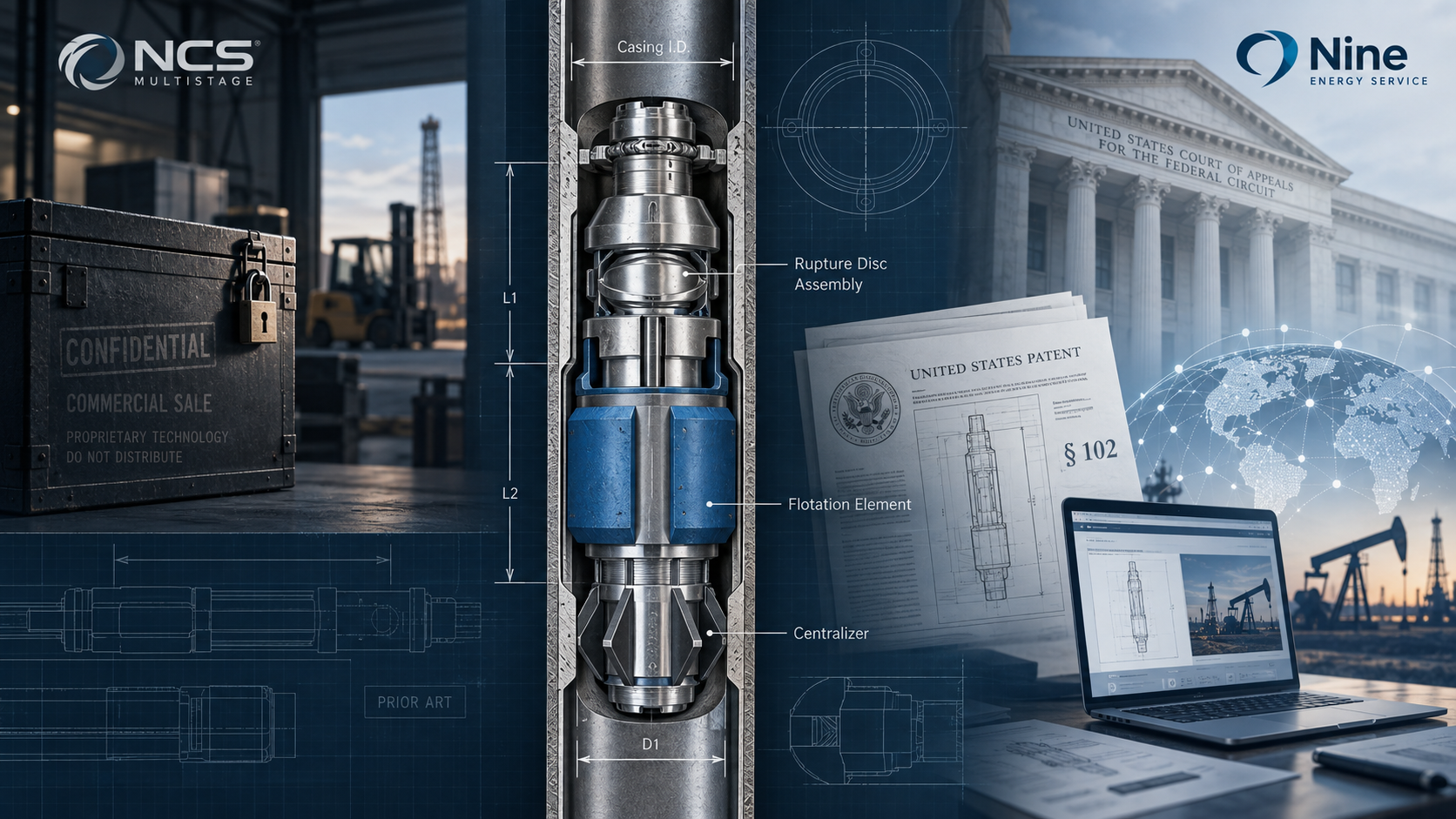
The Federal Circuit’s precedential decision in NCS Multistage Inc. v. Nine Energy Service, Inc., Case No. 2025-1000 (Fed. Cir. Sept. 14, 2026), vacated an infringement and no-invalidity judgment after identifying two claim-construction errors and rejecting the patent owner’s attempt to use an earlier private sale as a defensive “public disclosure” under the America Invents Act. The opinion’s most important doctrinal contribution is its application of Sanho Corp. v. Kaijet Technology International Ltd. to § 102(b)(1)(B), confirming that commercial activity does not create the statutory safe harbor unless the relevant subject matter was actually made available to the public.
The claim-construction rulings reinforce a related lesson. Courts may use intrinsic and extrinsic evidence to understand claim language, but they cannot give a repeated term different meanings or import an industry norm into the claims merely because doing so better fits the accused product, the prior art, or the way a technology is commonly used. In NCS Multistage, those errors affected both infringement and invalidity, requiring a new trial rather than a narrower correction of the judgment.
Background of the Dispute
NCS Multistage owns U.S. Patent No. 10,465,445, which concerns a casing flotation tool used in oil and gas wells. Long casing strings can encounter substantial friction when they are run into deep, horizontal, or deviated wellbores, and the patent addresses that problem by temporarily sealing a portion of the casing so that lower-density fluid can provide buoyancy. A rupture disc creates the temporary seal and can later be disengaged so that the casing passageway is reopened without the additional work associated with drilling out a conventional plug.
NCS accused Nine Energy Service’s BreakThru Casing Flotation Device of infringing the ’445 patent. A Western District of Texas jury found direct and induced infringement, rejected Nine’s invalidity defenses, and awarded damages, after which the district court entered an amended final judgment in NCS’s favor. The Federal Circuit vacated the infringement, no-invalidity, and damages judgments and remanded for further proceedings.
The patent claims priority to a provisional application filed on February 5, 2013, shortly before the AIA’s March 16, 2013 transition date. That timing could suggest that pre-AIA law governs, but the Federal Circuit agreed with the Patent Trial and Appeal Board that certain claims lacked support in the provisional application. Because the patent therefore contains claims with an effective filing date after March 16, 2013, post-AIA § 102 applies.
Claim Construction Must Follow the Intrinsic Record, Not Litigation Context
The two claim-construction errors involved different terms, but they reflected the same underlying problem: the district court allowed context outside the ordinary claim language to reshape the legal scope of the patent without sufficiently clear intrinsic support. One construction permitted “internal diameter” to shift meaning within the claims; the other converted a common industry dimension into a limitation on “casing string.” In both instances, the Federal Circuit returned to the basic hierarchy of claim construction: the claims and intrinsic record define scope, while prosecution history and extrinsic evidence can inform that inquiry but cannot manufacture a limitation that the patent does not establish.
For “internal diameter,” the district court had stated that the term’s plain and ordinary meaning could refer either to a measured diameter across the casing or to an inner surface extending along it. That flexibility mattered because the claims required the region where the rupture disc was attached to be “parallel to the internal diameter” of the casing string. Relying on Fin Control Systems Pty, Ltd. v. OAM, Inc., PODS, Inc. v. Porta Stor, Inc., and Paragon Solutions, LLC v. Timex Corp., the Federal Circuit emphasized the presumption that the same claim term carries the same meaning throughout a patent unless the specification or prosecution history clearly requires otherwise.
The intrinsic record did not provide that clarity. NCS argued that some uses of “internal diameter” necessarily referred to the casing’s inner surface because the patent described an internal diameter as “defining” a fluid passageway, but a measured line across the casing could define the dimensions of the passageway without changing the term into a longitudinal surface. The prosecution history likewise did not compel a different meaning. NCS had distinguished the Gano prior art because its rupture disc was attached along a sloped region, but that distinction remained valid whether “internal diameter” meant a measured diameter or the inner casing surface, so the prosecution argument did not establish an intentional shift in meaning.
The Federal Circuit therefore construed “internal diameter” as a measured diameter across the width of the casing string. That correction did not establish noninfringement as a matter of law, however, because portions of the BreakThru attachment structure could still be found parallel to the measured diameter depending on where the jury determines the rupture disc actually “attaches.” The point is narrower but important: correcting claim scope can change the factual infringement question without eliminating it.
The “casing string” construction presented the opposite form of the same problem. The district court construed the term as pipe “customarily ≥ 4.5 inches in outer diameter,” relying in part on industry evidence showing that 4.5 inches was a common casing dimension. The specification, however, repeatedly described casing strings by function rather than size and expressly described 4.5 inches as a common dimension while acknowledging that other dimensions were possible. Under Thorner v. Sony Computer Entertainment America LLC., that permissive language could not establish either lexicography or a clear disclaimer of smaller casing.
Nor could industry catalogs supply the missing limitation. Phillips v. AWH Corp. permits extrinsic evidence to help explain technology and usage, but the Federal Circuit has repeatedly treated the intrinsic record as the primary source of claim meaning. Evidence that most commercial casing products are 4.5 inches or larger may bear on how a factfinder understands the technology, but it does not transform a customary characteristic into a legal boundary of the claim when the patent itself permits alternatives.
That distinction mattered beyond semantic precision. NCS relied on the 4.5-inch construction to argue that TCO Group’s earlier TDP-PO device was a tubing tool rather than a casing tool and therefore did not satisfy the asserted claims. The Federal Circuit observed that the construction had put a “thumb on the scale” by suggesting how the jury should resolve a factual prior-art question. Claim construction is supposed to define what the patent claims, not signal whether a particular accused or prior-art device should be treated as satisfying those claims.
Taken together, the two rulings provide a useful constraint on claim-construction advocacy. A party cannot justify giving the same term different meanings merely because different meanings make the claim fit the specification or prosecution history more comfortably, and it cannot convert common industry practice into a limitation merely because that practice helps distinguish the prior art. The inquiry remains what the patent actually claims, not what construction best aligns the claim with the litigation theory.
Sanho and the Difference Between Commercial Activity and Public Disclosure
The more consequential portion of the opinion concerns the AIA’s prior-disclosure safe harbor. Section 102(b)(1)(B) excludes from prior art a disclosure made one year or less before the effective filing date if “the subject matter disclosed” had previously been “publicly disclosed” by the inventor, a joint inventor, or another who obtained the subject matter from an inventor. NCS relied on that language because it had sold its AirLock device to Tundra in July 2012, before TCO sold its TDP-PO tool to Apache in August 2012 and before Apache later used that device in a well operation.
NCS argued that the AirLock sale was an earlier public disclosure of the relevant subject matter and therefore prevented the later TCO activity from qualifying as prior art. The Federal Circuit rejected that theory under Sanho Corp. v. Kaijet Technology International Ltd., which had interpreted the materially identical “publicly disclosed” language in § 102(b)(2)(B). Sanho held that the fact an invention has been placed on sale, or even commercially exploited, does not itself establish that the subject matter of the invention was publicly disclosed for purposes of the safe harbor. The relevant question is whether it is reasonable to conclude that the invention, including the features that matter to the claim, was actually made available to the public.
The distinction is consistent with the Supreme Court’s treatment of the AIA’s on-sale bar in Helsinn Healthcare S.A. v. Teva Pharmaceuticals USA, Inc. A transaction may have legal consequences as a commercial sale even when the details of the invention are not publicly revealed. Sanho and NCS Multistage address the different question presented by the AIA’s safe-harbor language: whether the inventor’s earlier activity placed the relevant subject matter into the public domain sufficiently to neutralize an intervening disclosure by someone else.
NCS’s AirLock transaction did not satisfy that standard. The device was privately sold to a single customer, there was no evidence of broad distribution or public inspection, and the AirLock arrived inside a sealed black tube that would have to be cut open to expose its internal structure. Technical materials supplied with the product were marked confidential, and the record did not show that members of the public could learn the claim-relevant features of the rupture-disc assembly from the transaction. The absence of a nondisclosure agreement did not change the analysis because public disclosure turns on public accessibility to the relevant subject matter, not simply on whether the recipient undertook an express contractual duty of confidentiality.
The panel was careful not to turn that result into a categorical rule for every sale. Sanho had declined to define exactly what is necessary for a sale to publicly disclose the relevant subject matter, and NCS Multistage likewise stated that it did not need to go further than Sanho on the facts presented. The holding is therefore not that a sale can never qualify as a public disclosure, but that a commercial transaction does not trigger § 102(b)(1)(B) merely because the product changed hands or was commercially used.
That conclusion changed the invalidity case. Because NCS’s AirLock sale did not invoke the safe harbor, TCO’s August 2012 sale of the TDP-PO tool to Apache and Apache’s subsequent use were prior art to the ’445 patent as a matter of law. The Federal Circuit did not, however, hold the asserted claims invalid. NCS had advanced other arguments concerning whether the TDP-PO device met the claim limitations, and Nine had not shown that those theories were legally insufficient, so the court vacated the no-invalidity judgment and remanded for a new trial rather than entering judgment of invalidity.
For patent applicants and litigants, that distinction is the practical significance of the decision. Limited customer sales, private deployments, and other commercial activity may have consequences under § 102, but they should not be assumed to create a defensive public disclosure capable of neutralizing later third-party prior art. A party invoking § 102(b)(1)(B) must be able to show that the relevant subject matter, not merely the existence of the product or transaction, became available to the public.
The Errors Changed the Questions for the Jury
The opinion is also notable for how the different errors interacted. The corrected construction of “internal diameter” required a new infringement trial because factual questions remained about where the BreakThru rupture disc attached and whether that region was parallel to the measured diameter. On invalidity, the removal of the 4.5-inch “casing string” limitation changed how the TDP-PO prior art should be evaluated, while the § 102(b)(1)(B) ruling required the Apache sale and use to be treated as prior art. The Federal Circuit therefore vacated the infringement, no-invalidity, and damages judgments rather than attempting to preserve portions of a verdict that had been reached under materially different legal premises.
The remand also illustrates the limits of appellate correction. Because a jury could still resolve infringement either way under the corrected claim construction, and because NCS retained other invalidity responses, the Federal Circuit did not replace the jury’s verdict with its own factual findings. It instead reset the legal framework within which those factual issues must be decided. The court likewise did not reach Nine’s separate challenge to the construction of “disengage . . . from sealing engagement” or its damages-expert apportionment argument because the vacatur made those issues unnecessary to resolve.
A separate discovery ruling reinforces the same emphasis on fair presentation of the case rather than formal compliance with a deadline. Nine sought to use communications concerning possible TCO sales to Maersk that were produced two days before fact discovery closed, even though Nine had known for years that the TCO device was important and the information originated in part from Nine’s own CEO. Citing Innogenetics, N.V. v. Abbott Laboratories, the Federal Circuit affirmed the exclusion of that material, explaining that production before the literal discovery cutoff does not necessarily make a disclosure timely when the delay deprives the opposing party of a meaningful opportunity to investigate and respond.
Conclusion
NCS Multistage does not alter the Federal Circuit’s basic claim-construction methodology, but it shows how departures from that methodology can affect more than the infringement analysis. A term cannot shift meaning without clear intrinsic support, and an industry norm cannot be converted into claim scope merely because it is common or useful to a party’s theory of the case. When those mistakes influence both infringement and the treatment of prior art, the resulting verdict may need to be retried rather than merely adjusted.
The more lasting doctrinal contribution is the court’s application of Sanho to § 102(b)(1)(B). The AIA distinguishes between commercial activity and a disclosure that actually makes the relevant subject matter available to the public. An inventor’s earlier private sale therefore does not automatically create a safe harbor against intervening third-party prior art, and parties relying on the statute must focus on what the public could actually learn about the claimed invention.
Key Takeaways
- The same claim term ordinarily carries the same meaning throughout the patent unless the intrinsic record clearly requires otherwise.
- Common industry practice can explain technology, but it cannot impose a claim limitation that the patent itself does not establish.
- Under Sanho and NCS Multistage, commercial activity does not qualify as a “public disclosure” under § 102(b)(1)(B) unless the relevant subject matter was actually made available to the public.
- A prior-art ruling does not necessarily resolve invalidity. The Apache sale and use were prior art as a matter of law, but other factual disputes still required a new invalidity trial.
- Discovery evidence produced before the formal cutoff may still be excluded when a lack of diligence deprives the opposing party of a meaningful opportunity to investigate and respond.
Related Analysis
- Dental Monitoring v. Align: Federal Circuit Requires Written-Description Support for AIA Provisional Prior Art. That decision addresses another boundary of AIA § 102 and is useful alongside NCS Multistage because both cases turn on whether asserted prior art receives the statutory status a party claims for it.
- Magnolia v. Kurin: Separately Listed Claim Elements Require Separate Structures. The case illustrates the Federal Circuit’s continued insistence that claim construction follow the language actually chosen by the patentee rather than a litigation-driven reconstruction of that language.
- Board of Regents v. Boston Scientific: Federal Circuit Reverses Jury Verdict on Anticipation and the Meaning of “Fiber.” Like NCS Multistage, the decision shows how claim construction and prior-art questions can become intertwined and how an erroneous construction can alter the jury’s invalidity analysis.
- Socket Solutions v. Import Global: Federal Circuit Corrects Claim Constructions That Departed from the Intrinsic Record. The analysis provides a useful comparison for the Federal Circuit’s treatment of constructions that import limitations or meanings not adequately grounded in the patent itself.