The Federal Circuit’s precedential decision in Satius Holding, LLC v. Samsung Electronics Co., Ltd., No. 2025-1446 (Fed. Cir. Oct. 1, 2026), illustrates a counterintuitive principle of patent law: the clarity of a patent claim can establish precisely why it is invalid. The court held that a claim expressly covering a scientifically impossible method of transmitting signals was not indefinite under 35 U.S.C. § 112(b) because its scope was reasonably certain. But that same clarity made the claim invalid for lack of enablement under § 112(a), because no specification could teach a skilled artisan to practice the impossible alternative.
The decision clarifies the boundary between two distinct patent validity requirements. Indefiniteness concerns whether skilled artisans can understand what a patent claims; enablement concerns whether they can make and use what it claims. Satius demonstrates that a claim may satisfy the first requirement while necessarily failing the second.
Background of the Dispute
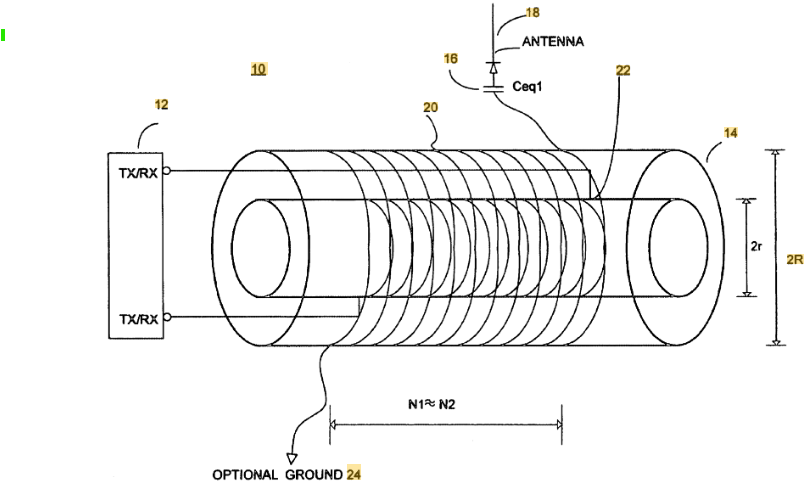
Satius asserted U.S. Patent No. 6,711,385 against Samsung, alleging infringement of claims 1, 11, and 18. The patent concerns a communications apparatus using a coupler to match a transmitter’s output impedance to what the patent describes as the characteristic impedance of air.
The preamble of representative claim 1 described an apparatus “for transmitting electric or electromagnetic signals over air.” The parties agreed that electromagnetic signals can propagate through air, but that transmitting signals through air while they remain in electric form is scientifically impossible.
Satius argued that the claim should instead be understood to describe electric signals within the apparatus that are converted into electromagnetic signals before transmission. The District of Delaware rejected that interpretation and held the asserted claims indefinite. On appeal, the Federal Circuit agreed that the claim encompassed the impossible alternative but disagreed about the resulting validity defect.
Claim Construction Could Not Rescue the Patent
The Federal Circuit first rejected Satius’s proposed construction because the claim did not recite an electric-to-electromagnetic conversion step. The specification’s use of similar language reinforced the conclusion that the disputed wording could not simply be treated as a drafting error.
Relying on Chef America, Inc. v. Lamb-Weston, Inc., the court emphasized that judges cannot rewrite otherwise clear claims to preserve their validity. Although claim language must be interpreted in light of the intrinsic record, construction cannot supply functionality absent from the only reasonable reading of the claim. Satius therefore could not escape the impossible alternative by asking the court to adopt a technically sensible but unsupported interpretation.
Why the Impossible Claim Was Not Indefinite
The central question was whether an admittedly impossible claim limitation necessarily renders a patent indefinite. The Federal Circuit held that it does not.
Under Nautilus, Inc. v. Biosig Instruments, Inc., § 112(b) requires claims to inform skilled artisans of their scope with reasonable certainty. As the Federal Circuit previously recognized in Miles Laboratories, Inc. v. Shandon Inc. and Exxon Research & Engineering Co. v. United States, whether an invention is operable is distinct from whether its boundaries are understandable. A claim can clearly describe something that cannot be accomplished.
The more difficult precedent was Synchronoss Technologies, Inc. v. Dropbox, Inc., where the Federal Circuit held claims indefinite after concluding that they required an impossibility. The court distinguished Synchronoss because the claims there were also nonsensical when considered alongside a specification indicating that they did not describe what the inventor regarded as the invention. In Satius, by contrast, the same impossible concept appeared consistently in the claims and specification. The parties understood what the claim purported to cover.
That distinction reveals the decision’s most significant insight. The drafting consistency that defeated Samsung’s indefiniteness argument simultaneously exposed Satius to an unavoidable enablement problem. Because the claim clearly encompassed an impossible alternative, its scope was sufficiently definite under § 112(b). But that clarity left no basis for avoiding the consequences of the claim’s breadth under § 112(a).
Why Full-Scope Enablement Was Fatal
Section 112(a) requires a patent specification to enable skilled artisans to make and use the claimed invention. In Amgen Inc. v. Sanofi, the Supreme Court reaffirmed that this requirement extends to the full scope of what the patent claims, not merely selected embodiments that the disclosure enables.
The Federal Circuit applied that principle directly. Because claim 1 expressly encompassed both electromagnetic transmission and the scientifically impossible transmission of electric signals over air, its full scope could never be enabled. The problem was not simply that the specification lacked sufficient technical detail. No amount of additional disclosure could make the impossible alternative operable.
The court’s reliance on Liebel-Flarsheim Co. v. Medrad, Inc. illustrates the relationship between claim breadth and enablement. There, broadly construed claims covered injector systems with and without a pressure jacket, although the specification did not adequately enable the jacketless configuration. Satius presented the same structural problem in a more absolute form: the claim extended beyond what the specification could enable because one expressly claimed alternative was physically impossible.
The court also relied on EMI Group North America, Inc. v. Cypress Semiconductor Corp. and Process Control Corp. v. HydReclaim Corp., which addressed impossible modes of operation. Satius therefore does not establish a new enablement requirement. Rather, it applies established full-scope principles to a claim whose undisputed meaning made invalidity unavoidable.
An Alternative Ground for Affirmance
Although the district court had declined to decide enablement, concluding that Samsung waived the issue, the Federal Circuit affirmed invalidity on that alternative ground. Citing Singleton v. Wulff and Icon Health & Fitness, Inc. v. Strava, Inc., the panel found appellate resolution appropriate because enablement had been adequately briefed, the underlying scientific impossibility was undisputed, and remand would serve no useful purpose. The holding illustrates the availability of alternative grounds for affirmance when the record permits a purely legal resolution, rather than establishing a general practice of deciding fact-intensive enablement questions for the first time on appeal.
Practical Implications
For patent drafting and prosecution, Satius underscores the risks of expressly claiming alternative technologies without confirming that each alternative is operable and enabled. A disjunctive limitation covering “A or B” extends the claim to both alternatives. If one is scientifically impossible, the patentee cannot rely on the operability of the other to satisfy full-scope enablement. Nor will repeating the problematic language in the specification necessarily help. As Satius demonstrates, consistency may establish what the claim means while confirming that the disclosed invention cannot satisfy the scope claimed.
For patent litigation, the decision provides a useful framework for distinguishing § 112 defenses. If an impossible limitation makes claim boundaries uncertain, indefiniteness may be appropriate under Nautilus and Synchronoss. If the limitation clearly encompasses something impossible to practice, enablement may be the stronger challenge. The decision also reinforces a broader claim-construction lesson: a patentee cannot seek broad language for infringement purposes and then rely on an unclaimed narrowing interpretation to avoid the validity consequences of that breadth.
Conclusion
Satius Holding v. Samsung illustrates how the same claim language can produce opposite results under different provisions of § 112. The claim was definite because its impossible alternative was understandable, yet invalid because that alternative could not be enabled. The case reinforces an important distinction for patent practitioners: clarity establishes what a patent claims, but it does not establish that the patent enables what it claims.
Key Takeaways
- Scientific impossibility does not automatically render a patent claim indefinite. Under § 112(b), the question is whether skilled artisans can understand its scope with reasonable certainty.
- The same clear claim language that defeats indefiniteness may establish invalidity under § 112(a) if the claim expressly encompasses an impossible alternative.
- Courts cannot rewrite unambiguous claims to supply missing functionality or preserve validity.
- Under Amgen and related precedent, a specification must enable the full claimed scope, not merely its operable alternatives.
Related Analysis
- Wyeth v. AstraZeneca — Examines the full-scope enablement requirement where a patent specification failed to enable the claimed therapeutic treatment.
- Brita v. ITC — Addresses the relationship between broad functional claiming, written description, and enablement.
- Enviro Tech v. Safe Foods — Provides a contrasting example of indefiniteness arising from uncertainty about claim boundaries.
- Moskowitz v. Globus — Examines how language in a patent claim’s preamble can affect claim scope.