The Federal Circuit’s August 11, 2026 order denying panel rehearing and rehearing en banc in Range of Motion Products, LLC v. Armaid Company Inc., Case No. 23-2427 (Fed. Cir. August 11, 2026), leaves intact a precedential design patent decision that gives judges significant responsibility at two stages of infringement litigation. Courts may construe a design patent to distinguish functional from ornamental aspects, and they may resolve infringement at summary judgment when the claimed and accused designs are plainly dissimilar.
The rehearing order does not create a new infringement test. Its significance lies instead in a sharp disagreement over a more fundamental issue: how much of design patent infringement should be decided by judges rather than juries.
The August rehearing proceedings sharpen that earlier disagreement, expanding it beyond the “plainly dissimilar” inquiry to a broader debate over whether judges or juries should decide the functionality and ornamentality questions that define design patent scope.
Four judges dissented from the denial of rehearing en banc. Chief Judge Moore, joined by Judge Reyna, argued in a written dissent that Federal Circuit doctrine has shifted core factual questions away from juries. Judges Stoll and Stark dissented without opinion. Judge Cunningham, who authored the February panel majority, joined by Judge Hughes, defended the existing framework in a concurrence.
For Charles Gideon Korrell, the case matters less because the governing rule changed than because the separate opinions expose a significant disagreement within the Federal Circuit about the allocation of decision-making authority in design patent cases.
Background: A Product Where Form and Function Overlap
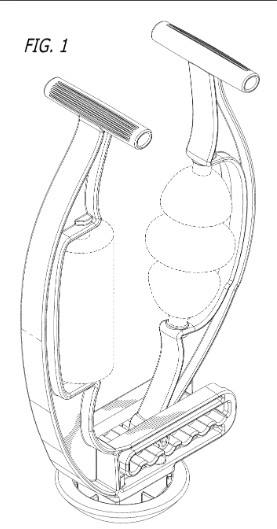
Range of Motion Products owns U.S. Design Patent No. D802,155, covering the ornamental design of a body-massaging apparatus embodied in its Rolflex product. Armaid’s accused Armaid2 is also a handheld massaging device.
The dispute illustrates a recurring difficulty in design patent law because visible features can contribute simultaneously to appearance and operation. The products include curved arms, handles, rollers, a hinge mechanism, and a base, many of which have both functional and visual characteristics.
The district court concluded that many, but not all, features of the patented design were driven by function and that the protected ornamental scope was therefore narrow. It granted summary judgment of noninfringement after concluding that no reasonable jury could find the Armaid2 substantially similar to the claimed design.
A divided Federal Circuit panel affirmed on February 2, 2026. As discussed in this Blog’s earlier analysis of the panel decision, the majority upheld both the district court’s functionality-based claim construction and its conclusion that the designs were plainly dissimilar. The August rehearing order leaves that precedential decision in place while revealing a substantially broader disagreement within the court over the proper roles of judges and juries.
The “Plainly Dissimilar” Shortcut Survives
The first disagreement concerns the relationship between Gorham Co. v. White, 81 U.S. 511 (1872), and Egyptian Goddess, Inc. v. Swisa, Inc., 543 F.3d 665 (Fed. Cir. 2008) (en banc).
Gorham established the ordinary-observer test. Infringement turns on whether the overall visual effect of the claimed and accused designs would appear substantially the same to an ordinary observer giving the attention a purchaser ordinarily would.
Egyptian Goddess later rejected the separate “point of novelty” test and reaffirmed the ordinary-observer test as the sole infringement test. Prior art supplies an important frame of reference because differences that may appear insignificant in isolation can become important when the patented design lies close to earlier designs.
But Egyptian Goddess also recognized that some claimed and accused designs will be sufficiently distinct that the patentee cannot establish substantial similarity without proceeding further. Later cases, including Ethicon Endo-Surgery, Inc. v. Covidien, Inc., describe this as the “plainly dissimilar” inquiry.
Chief Judge Moore argued that this formulation has produced more than a semantic change. In her view, asking whether designs are “plainly dissimilar” encourages courts to identify individual differences rather than ask whether the designs are substantially similar in overall appearance. She pointed to empirical material presented by amici concerning the effect of framing and to Range of Motion, Ethicon, and the nonprecedential North Star Technology International Ltd. v. Latham Pool Products, Inc. as examples of cases she believed reasonable jurors should have been permitted to decide.
Her proposed approach would not eliminate summary judgment. Moore acknowledged that courts could still dispose of genuinely clear cases as a matter of law, citing PS Products Inc. v. Panther Trading Co. as an example. Her concern was instead that a shortcut intended for obvious cases had expanded into a mechanism for resolving much closer visual comparisons.
Judge Cunningham rejected that criticism. Gorham itself requires consideration of both similarities and differences, he reasoned, with the controlling inquiry remaining the overall visual effect. “Plainly dissimilar” therefore does not replace the substantial-similarity test. It identifies cases in which no reasonable factfinder could find infringement.
The concurrence also emphasized that Range of Motion was an especially poor vehicle for changing the rule. The district court not only compared the claimed and accused designs directly, but also conducted the three-way comparison with the prior art contemplated by Egyptian Goddess. It reached the same noninfringement conclusion under both approaches.
The practical rule therefore remains unchanged. An accused infringer may seek summary judgment based on a direct comparison when the designs are plainly dissimilar without establishing that a prior-art comparison is mandatory in every case. Prior art nevertheless remains potentially important where the designs are sufficiently similar to require a more refined ordinary-observer analysis.
Functionality Remains Part of Judicial Claim Construction
The second dispute reaches more deeply into the division of responsibility between judges and juries.
Under OddzOn Products, Inc. v. Just Toys, Inc. and Sport Dimension, Inc. v. Coleman Co., courts construing design patent claims identify the protected ornamental aspects of designs that also contain functional elements. Lanard Toys Ltd. v. Dolgencorp LLC accordingly describes design patent infringement as a two-part process: the court first construes the claim, and the factfinder then compares the properly construed claim with the accused design.
The February panel applied that framework to the shape of the Rolflex arms. Among other evidence, the court considered a related utility patent, an inventor affidavit, and marketing materials describing the functional advantages of the product’s curved arms. It also rejected the argument that evidence of alternative designs must operate as a threshold bar to finding functionality. Alternative designs remain important and can be dispositive in an appropriate case, but they are part of a broader functionality analysis.
Chief Judge Moore’s en banc dissent expanded upon the objection she had raised in her panel dissent. She argued that determining which visual aspects are functional or ornamental itself involves factual judgments that should ordinarily be made by a jury.
Judge Cunningham relied on Markman v. Westview Instruments, Inc. and Teva Pharmaceuticals USA, Inc. v. Sandoz, Inc. in rejecting that position. Claim construction remains an ultimate question of law even when subsidiary factual findings are necessary. The concurrence reasoned that design patents, like utility patents, define property rights whose boundaries must be determined before infringement is assessed.
The concurrence also emphasized that design patent claim scope can depend on legal considerations extending beyond functionality, including drafting conventions such as broken lines and representations made during prosecution. The Federal Circuit recently reinforced the importance of prosecution history in Top Brand LLC v. Cozy Comfort Co., holding that a design patentee may surrender claim scope through representations to the Patent Office.
An important distinction follows. Functionality plays different roles in design patent validity and infringement. For validity, a design is vulnerable if its overall appearance is dictated by function and therefore primarily functional. Claim construction asks a different question: even when the patent remains valid, functional aspects of particular features can limit the scope of the ornamental design protected by the patent.
Functional structures do not simply disappear from the infringement comparison. Sport Dimension cautions against eliminating entire structural elements merely because they perform useful functions. Courts must still identify the ornamental aspects of those structures and consider how those aspects contribute to the overall visual design.
The August order therefore leaves an important allocation rule intact. Judges may make the claim-construction determinations necessary to define the protected ornamental design, including subsidiary findings concerning functionality, before the ordinary-observer infringement question reaches a jury.
Practical Implications
For design patent owners, Range of Motion makes the claim-construction record increasingly important. Concomitant utility patents, inventor explanations, and advertising that emphasizes the performance advantages of visible features may later support an argument that aspects of those features are functional. Evidence of feasible alternative designs can point in the opposite direction by demonstrating that particular visual choices were not required to achieve the product’s utility.
Patent prosecution deserves equal attention. Broken-line conventions and representations to the Patent Office can affect claim scope independently of functionality. Design patent applicants therefore should consider not only which features are claimed, but also how prosecution positions may later shape the infringement comparison.
For accused infringers, the decision preserves two potentially powerful routes to early resolution. Functionality evidence can narrow the protected ornamental scope during claim construction, while a plainly dissimilar comparison can support summary judgment without requiring a prior-art analysis as an indispensable first step. Prior art remains valuable as an additional frame of reference and, as in Range of Motion, may provide an alternative basis for noninfringement.
Charles Gideon Korrell views the decision as reinforcing the importance of developing these issues early. Patentees should build evidence showing ornamental choice and overall visual similarity. Accused infringers should separately develop functionality evidence, prosecution-history arguments, and prior art that may limit the claimed design or sharpen the ordinary-observer comparison.
Conclusion
The Federal Circuit did not rewrite design patent law in Range of Motion. It declined an invitation to reconsider it en banc.
The February panel opinion therefore remains controlling Federal Circuit precedent. Judges may construe design patent claims to distinguish functional from ornamental aspects, and courts may grant summary judgment when the claimed and accused designs are plainly dissimilar. Prior art remains important to the ordinary-observer inquiry, but it is not an invariably required first step before noninfringement can be found.
The more consequential development is the disagreement exposed by the rehearing proceedings. Chief Judge Moore views current doctrine as allowing judges to decide visual and functional questions that properly belong to juries. Judge Cunningham views those same determinations as necessary claim construction that defines the boundaries of the patent before a jury can assess infringement.
Charles Gideon Korrell believes that institutional disagreement is what makes Range of Motion worth watching. The governing law has not changed, but four judges dissented from the denial of en banc rehearing, and two articulated a substantial challenge to the current allocation of authority between judges and juries. The fault line is now clearly visible.
Key Takeaways
- The February 2026 precedential panel decision and the existing design patent infringement framework remain intact.
- Egyptian Goddess continues to permit a “plainly dissimilar” route to noninfringement without requiring a prior-art comparison in every case.
- Functionality remains part of judicial design patent claim construction, even when resolving functionality requires subsidiary factual findings.
- Functionality for claim construction is distinct from the inquiry into whether an overall design is invalid because it is dictated by function.
- Functional structures remain part of the visual design to the extent their ornamental aspects contribute to the overall appearance.
- Utility patents, inventor statements, marketing materials, alternative designs, prosecution history, and prior art can become important evidence, but they perform different roles in the analysis.
Related Analysis
- For the February 2026 panel decision that remains controlling, see Range of Motion Prods v. Armaid: Narrow Design Patent Scope and the Growing Role of “Plainly Dissimilar”
- Socket Solutions v. Import Global: Federal Circuit Demands Doctrinal Discipline Before Granting Preliminary Patent Injunctions provides a utility-patent comparison on the judicial role in claim construction.
- Magnolia v. Kurin: Separately Listed Claim Elements Require Separate Structures illustrates another Federal Circuit decision treating claim construction as a legal question with concrete structural consequences.
- Ridge Corp. v. Kirk NationaLease: Federal Circuit Rejects Preliminary Injunction Based on Claim Construction and Speculative Harm addresses when claim construction permits early disposition at the preliminary-injunction stage.