The Federal Circuit’s decision in Constellation Designs, LLC v. LG Electronics Inc., No. 24-1822 (Fed. Cir. Aug. 31, 2026), draws an unusually clear line under 35 U.S.C. § 101 between claiming a technological objective and claiming a particular technological implementation. The court held claims broadly covering signal constellations “optimized” for improved capacity patent ineligible, while affirming the eligibility of claims reciting specific non-uniform constellation structures. The decision also clarifies that industry standards may be used to prove infringement on a limitation-by-limitation basis, an important rule for patent disputes involving standardized technologies.
The court’s modified opinion, reissued following a petition for rehearing, leaves the appellate result unchanged but materially narrows one aspect of the damages discussion. The court’s comparable-license and expert-admissibility analysis remains intact. But as to LG’s separate request to vacate the damages award because several asserted claims were held ineligible, the modified opinion now relies solely on forfeiture. The change leaves unresolved what should happen to a single royalty award when some of the patent claims underlying the verdict later fail.
From Signal Constellations to ATSC 3.0 Television
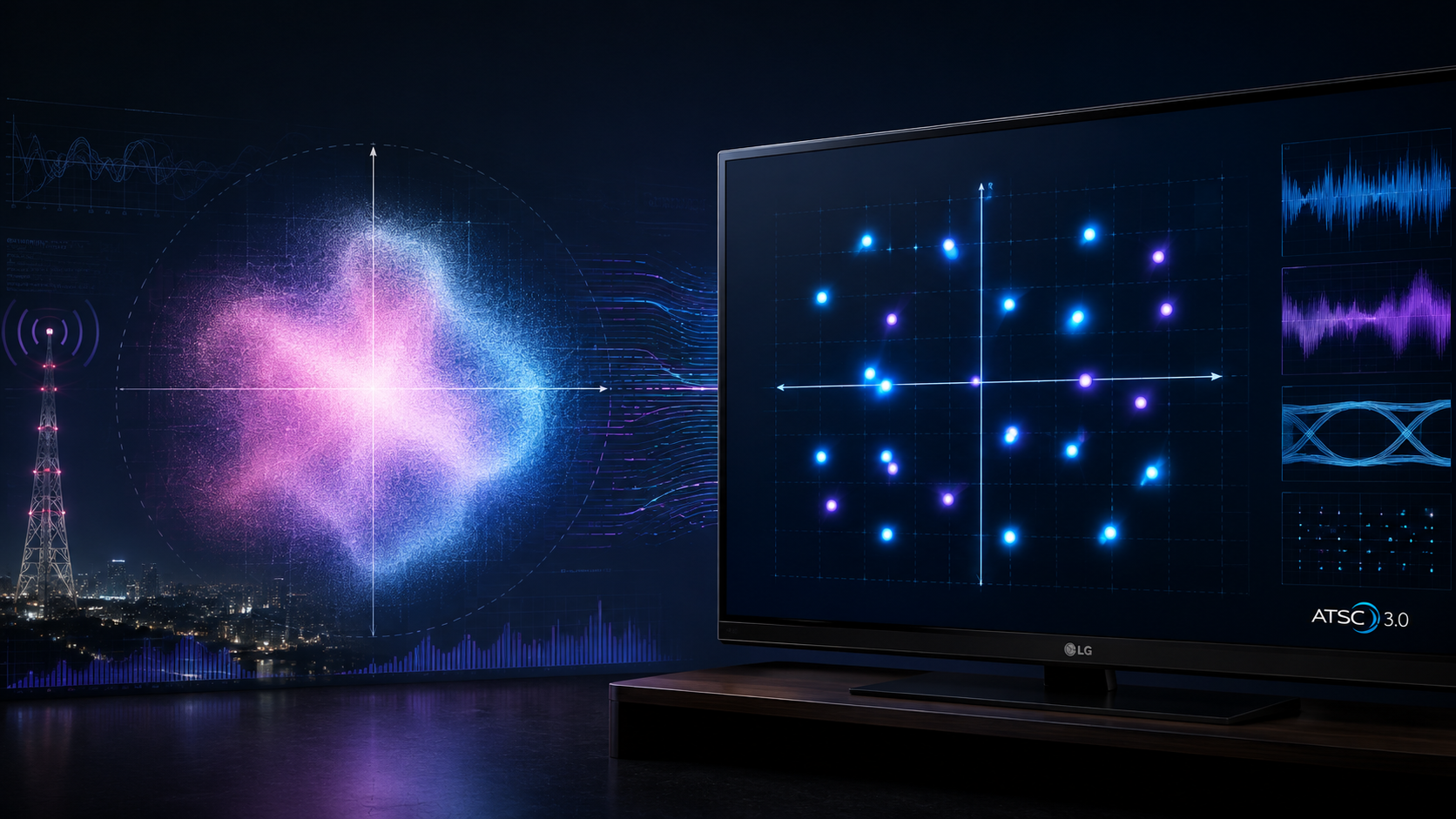
The patents concern digital communications and, more specifically, how digital information is represented for transmission through noisy communications channels. Digital systems commonly translate groups of bits into symbols positioned within a mathematical “constellation.” A receiver uses that same constellation to translate the received signal back into digital information.
Traditional constellation design emphasized maximizing the minimum distance between constellation points, known as dmin. Greater separation helps receivers distinguish among symbols when transmission introduces noise.
The inventors took a different approach. Rather than optimizing primarily for the distance between constellation points, they sought to optimize constellations using “parallel decode capacity,” or PD capacity. Their work led to non-uniform constellations in which points could be unevenly spaced and, in some configurations, could occupy the same location. The patents describe an iterative optimization process for identifying constellations capable of achieving improved communications performance at lower signal-to-noise ratios.
The commercial significance of the dispute arose from standardization. Constellation asserted the patents against LG televisions compatible with ATSC 3.0, the next-generation over-the-air television standard, and particularly the A/322 physical-layer protocol. Standardization can magnify the importance of a communications technology because the same technical requirements may be implemented across large numbers of products from multiple manufacturers.
A jury found infringement of nine claims from four patents, awarded $1,684,469 in past damages based on a $6.75-per-television royalty, and found the infringement willful. The district court also imposed an ongoing royalty at the same rate.
Why the Optimization Claims Failed Section 101
The eligibility dispute turned on two materially different groups of claims. The first group, from the ’761 and ’700 patents, claimed communication systems using constellations “optimized for capacity using parallel decode capacity” to provide a specified capacity at a lower signal-to-noise ratio than conventional constellations. The Federal Circuit referred to these as the “optimization claims.”
The problem was not that optimization, mathematics, or signal processing is categorically unpatentable. It was that the claims stated what the optimized constellation should accomplish without claiming a particular way of achieving that result.
Representative claim 17 of the ’761 patent illustrates the problem. It required a QAM symbol constellation optimized for PD capacity so that it provided a given capacity at a reduced signal-to-noise ratio compared with a conventional constellation designed to maximize dmin. But the claim did not specify how the constellation was to be optimized for PD capacity.
The specification contained considerably more detail. It described selecting a constellation size and desired capacity, estimating the signal-to-noise ratio, optimizing the constellation for the selected capacity measure, determining the signal-to-noise ratio at which the optimized constellation achieved the desired capacity, and iterating until the values converged. Those implementation details did not appear in the claim. Relying on Synopsys, Inc. v. Mentor Graphics Corp., the Federal Circuit emphasized that the § 101 inquiry focuses on the asserted claims themselves, while ChargePoint, Inc. v. SemaConnect, Inc. confirms that unclaimed technical details from the specification cannot be imported into the claims. The court therefore concluded that claim 17 was directed to the abstract idea of optimizing a constellation for PD capacity because it effectively covered all ways of achieving the claimed optimization result.
O’Reilly v. Morse supplied the foundational principle. The Supreme Court allowed Samuel Morse to claim particular implementations of his telegraph invention but rejected a claim broad enough to cover the use of electromagnetism to print characters at a distance regardless of how that result was achieved. Interval Licensing LLC v. AOL, Inc. later described the same problem as result-oriented claiming that encompasses all solutions for achieving a desired outcome.
ChargePoint brought that principle into modern technology. The patent there described network-connected electric-vehicle charging stations, but the Federal Circuit concluded that the broad claims captured the objective of networked charging without claiming a sufficiently particular technological implementation. The same distinction controlled in Constellation Designs: a detailed specification could help identify the technological problem and explain what the inventors had accomplished, but it could not import the missing optimization process into the claims.
The optimization claims also failed Alice step two. Constellation argued that its approach was innovative, generated significant efficiency improvements, and had been credited as the first development of the relevant type of optimized constellation. But novelty and nonobviousness under §§ 102 and 103 do not themselves establish an inventive concept under § 101.
Nor could the optimization itself serve as the inventive concept after the court had already identified that optimization as the abstract idea. As the Federal Circuit explained through Two-Way Media Ltd. v. Comcast Cable Communications, LLC, the inventive concept that saves a claim at step two must be evident in the claim. The court therefore held the ’761 and ’700 optimization claims patent ineligible, vacated the district court’s summary judgment that those claims were eligible, and remanded for further proceedings.
Why the Specific Constellation Claims Survived Section 101
The claims from the ’509 and ’922 patents presented the other side of the eligibility line. Those claims did not broadly instruct a communication system to optimize a constellation for PD capacity. They recited particular non-uniform constellation structures developed through the inventors’ work. Representative claim 21 of the ’509 patent, for example, required a constellation with multiple unique point locations that were unequally spaced, with constellation points having different labels and at least two differently labeled points occupying the same location.
That last feature was counterintuitive under conventional approaches to constellation design. Traditional thinking emphasized separating points so a receiver could distinguish among transmitted symbols. The inventors’ PD-capacity analysis led them to configurations in which overlapping locations could improve coding gains.
The ’922 patent likewise claimed specific non-uniform constellation configurations rather than the general objective of optimizing a constellation. The Federal Circuit treated those limitations as a concrete implementation of a technological improvement. The problem was technical: overcoming capacity constraints in digital communications to improve coding gains. The claims recited a particular technological solution in the form of specific constellation structures, and the court therefore concluded at Alice step one that they were not directed to an abstract idea. That treatment is consistent with CardioNet, LLC v. InfoBionic, Inc., 955 F.3d 1358, 1371 (Fed. Cir. 2020), which likewise recognized claims directed to a concrete technological improvement as eligible at Alice step one.
That comparison is the most instructive aspect of Constellation Designs. The difference was not whether the underlying engineering work was innovative. The same technological development could support both ineligible and eligible claims. What mattered was what each claim actually required.
Nor is the lesson simply that more claim detail is always better. The eligible claims did not merely add descriptive language to the objective of optimization. They claimed particular technological configurations resulting from the inventive work. The decision therefore distinguishes between claiming the goal of an optimization process and claiming a concrete technological implementation of the solution.
Industry Standards Can Prove Individual Claim Limitations
The court’s infringement ruling may prove nearly as important in cases involving standardized technologies. At trial, Constellation relied on ATSC 3.0 and A/322 standards documents to establish some limitations while using product-specific evidence for others. LG argued that Federal Circuit precedent permitted standards-based proof only when compliance with the standard necessarily established every limitation of the asserted claim. The Federal Circuit rejected that all-or-nothing interpretation.
Under Fujitsu Ltd. v. Netgear Inc., comparison to an industry standard can establish infringement when practicing the relevant standard necessarily practices the patent claim. Constellation Designs makes explicit that the same principle operates on a limitation-by-limitation basis.
A patent owner therefore may establish some claim limitations through a standard and establish other limitations through evidence concerning the accused product. For each limitation established through the standard, however, two requirements remain important. First, the relevant portion of the standard must be sufficiently specific that practicing it would necessarily practice the limitation. Second, that portion of the standard must be mandatory, or the patent owner must separately establish that the accused product implements the optional feature.
The record in Constellation Designs illustrates how the rule works in practice. Constellation did not rely on standards documents alone. Its technical expert also relied on testing of LG televisions, ATSC documents, LG source code, and internal testing materials. The jury heard evidence concerning the accused televisions’ ability to receive ATSC 3.0 signals using the relevant constellations, as well as evidence concerning the chips and decoding functionality in the accused products.
The result is not a rule that standards compliance automatically establishes infringement. Instead, standards-based proof and product-specific evidence may be combined within the same infringement analysis.
That approach has practical importance in standards-intensive technologies. When every compliant product necessarily implements the same mandatory technical requirement, Fujitsu recognizes little value in repeatedly proving the same limitation separately for each device. Constellation Designs confirms that the same logic applies even when the standard establishes only some limitations of the asserted claim.
For patent owners, standards documents may therefore reduce the amount of product-specific proof required for particular limitations. Accused infringers, correspondingly, should examine whether the cited provision is actually mandatory, whether optional functionality is implemented, and whether the standard is sufficiently specific to establish what the claim requires.
The opinion therefore gives practitioners an unusually useful comparison within one technological setting: detailed disclosure of an inventive optimization process could not save claims to the optimization result, while claims requiring concrete structures identified through that work survived at Alice step one.
The Modified Damages Opinion Leaves a Separate Question Open
LG also challenged Constellation’s $6.75-per-television royalty. Constellation’s damages expert, Dr. Sullivan, relied on licenses involving Zenith patents and concluded that those agreements supplied sufficient built-in apportionment for his reasonable-royalty analysis. The Federal Circuit affirmed the district court’s denial of LG’s JMOL motion and its motion to exclude Dr. Sullivan’s testimony.
The record contained evidence supporting both technical and economic comparability. Constellation’s technical expert testified that the Zenith patents and asserted patents addressed similar features and decoding technologies, concerned specific signal constellations, were used in the physical layer of television standards, and produced similar technological benefits.
Dr. Sullivan also identified economic similarities. The licenses concerned televisions, used running royalties, granted non-exclusive rights, extended through the lives of the patents, applied to U.S.-connected sales, and involved similarly situated parties. LG’s own corporate representative testified that the Zenith licenses used a single royalty rate regardless of how many Zenith patents were found infringed.
The court also emphasized the procedural distinction between admissibility and evidentiary sufficiency. LG framed much of its post-trial attack as a JMOL challenge even though the substance of the objection concerned the factual foundation and reliability of expert testimony. Under EcoFactor, Inc. v. Google LLC and Versata Software, Inc. v. SAP America, Inc., challenges of that kind belong primarily within the Rule 702 and Daubert framework.
A different damages issue arose because the Federal Circuit simultaneously held five asserted claims patent ineligible. In the original April opinion, the court first observed that LG had waited until oral argument to contend that loss of those claims required vacating the damages award and therefore had forfeited the argument. The original opinion then went further, explaining that Dr. Sullivan had valued the asserted patents at the technology level rather than attributing separate value to individual patents or claims.
The August 31 modified opinion deleted that additional discussion, leaving the footnote to end with forfeiture. The change is significant because the modified opinion does not establish that a technology-level or undifferentiated royalty necessarily survives when some of the asserted claims supporting the verdict are later lost. Nor does it hold that such an award necessarily must be reduced. Because LG did not timely preserve the issue, the court did not decide it.
For damages practitioners, the modification creates two distinct preservation lessons. Challenges to the reliability or factual foundation of comparable-license testimony should be developed through Rule 702 and Daubert. Separately, a party contending that the loss of some asserted patents or claims requires vacating or recalculating an undifferentiated damages award should expressly preserve that argument rather than first raising it at oral argument.
Practical Implications
The most immediate lesson concerns patent drafting. When an invention involves optimization, signal processing, machine learning, or another computational technique, identifying a valuable technological objective may not be sufficient. Claims should, where the invention supports it, capture the mechanisms, constraints, architecture, steps, or resulting technological structures that distinguish the invention from the underlying objective.
The contrast among the Constellation patents makes that principle unusually concrete. A detailed optimization process in the specification did not save claims drafted around the result of optimizing PD capacity. Claims directed to specific constellation configurations survived because the claimed subject matter itself embodied the technological solution.
For companies developing algorithmically generated technologies, the decision may also affect portfolio strategy. The commercially important invention may include both a process for discovering an improved configuration and the configuration produced by that process. Constellation Designs illustrates why claims directed to different aspects of the same technological advance can have materially different eligibility consequences.
The infringement ruling should likewise influence discovery and proof strategies in standards-related cases. Patent owners may be able to establish standardized portions of an accused system through authoritative standards documents while reserving source code, testing, technical documentation, and expert analysis for limitations the standard does not necessarily establish. Defendants should scrutinize whether cited provisions are mandatory, whether optional features are actually implemented, and whether the language of the standard is sufficiently specific to satisfy the claimed limitation.
Finally, the damages ruling reinforces the importance of procedural precision. Constellation Designs does not retreat from EcoFactor‘s insistence that courts perform their Rule 702 gatekeeping function. It instead shows that comparable-license testimony can survive when the expert has an adequate factual basis for technical and economic comparability. At the same time, the modified opinion demonstrates that a different objection—the consequences of losing some asserted claims for an existing royalty award—must itself be timely preserved.
Conclusion
Constellation Designs v. LG Electronics demonstrates that § 101 can turn on fine but consequential distinctions in what a patent claim actually requires. The Federal Circuit held the optimization claims ineligible because they captured the objective of optimizing communications performance without limiting that objective to a particular method or implementation. Claims covering specific signal constellations survived because they recited concrete technological structures that addressed the identified communications problem.
The decision also provides an important clarification of Fujitsu. Industry standards may establish infringement one limitation at a time rather than operating only on an all-or-nothing basis, provided the relevant portion of the standard necessarily satisfies the particular limitation and is mandatory or actually implemented.
The modified damages discussion adds a separate lesson. The court affirmed the use of comparable Zenith licenses and the admission of Constellation’s damages testimony, but because LG did not timely preserve the issue, it did not decide whether the loss of some asserted claims requires vacating or recalculating an otherwise undifferentiated royalty award.
Key Takeaways
- Result-oriented optimization claims remain vulnerable under § 101 even when the specification describes a detailed and technically innovative method for reaching the claimed result.
- Claims directed to specific technological configurations may survive Alice even when those configurations were developed through mathematical or computational optimization.
- Under Fujitsu, industry-standard evidence may establish individual claim limitations when practicing the relevant standard necessarily satisfies those limitations.
- Standards-based infringement proof can be combined with product-specific evidence within the same claim analysis.
- Comparable-license challenges directed to an expert’s factual foundation or methodology should be preserved through Rule 702 and Daubert, while any contention that partial invalidation requires recalculating an existing damages award should be separately and expressly preserved.
Related Analysis
- Recentive v. Fox: Generic Machine Learning in a New Field Is Not Patent Eligible examines a related problem in computational patent claims, where applying sophisticated optimization technology without claiming a sufficiently particular technological advance failed § 101.
- US Patent No. 7,679,637 LLC v. Google LLC: Functional Claiming Meets Alice Again provides a useful comparison with the Federal Circuit’s continuing skepticism toward claims that define technological functionality principally by the result to be achieved.
- Contour v. GoPro: POV Camera Claims Survive Section 101 illustrates the other side of the eligibility line, where claims directed to sufficiently specific technological improvements survived at Alice step one.
- EcoFactor v. Google: En Banc Federal Circuit Tightens Daubert Review of Patent Damages Experts provides the principal context for Constellation Designs‘ treatment of comparable licenses, expert foundations, and the court’s Rule 702 gatekeeping obligation.